
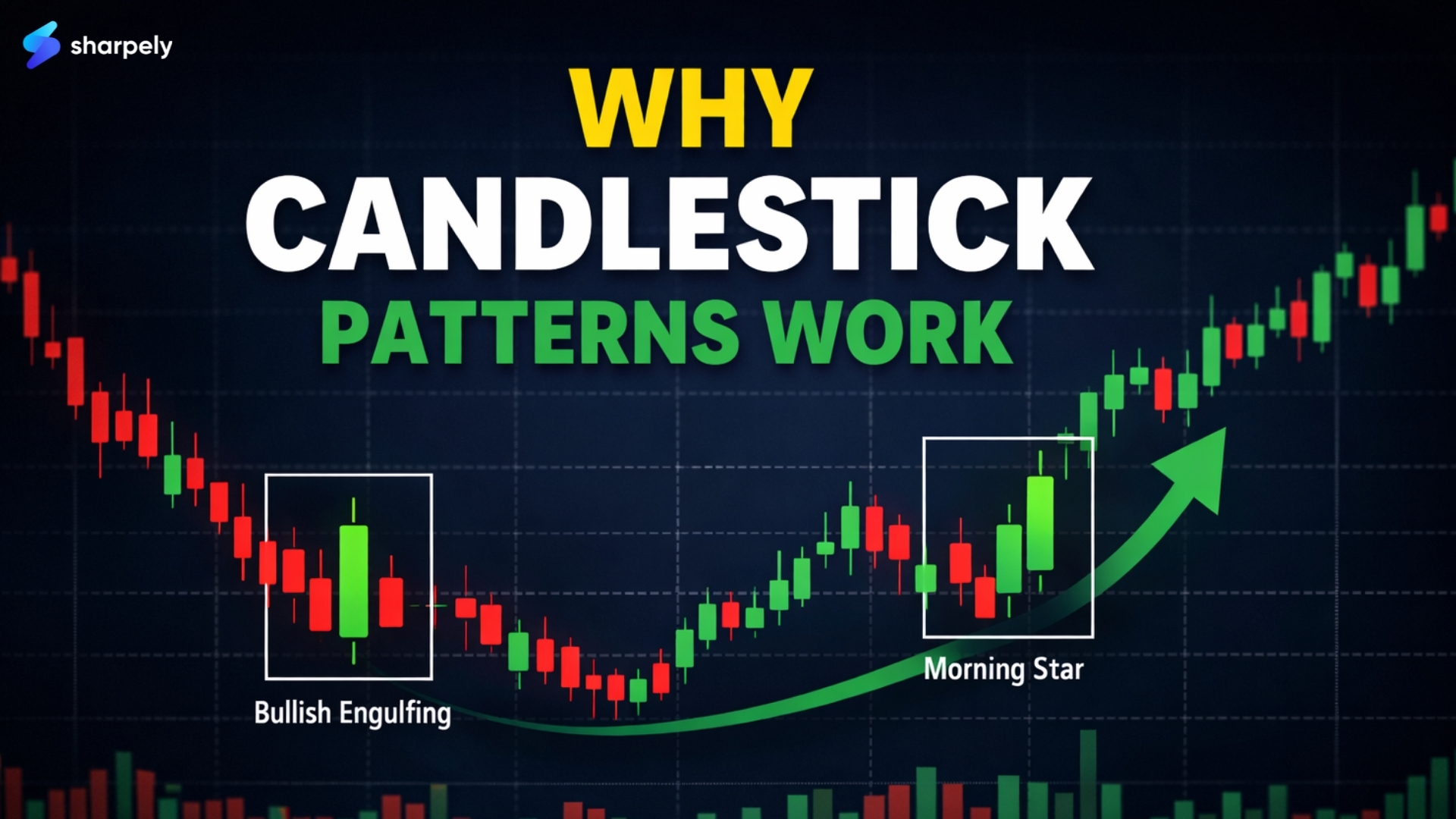
Introduction: Candlesticks Are Not Magic — They’re Psychology
If candlestick patterns were unreliable, professional traders wouldn’t still use a charting method that originated over 300 years ago. Yet, even today, price action and candlestick structures remain at the core of trading decisions across Indian stock markets.
The problem isn’t the patterns. The problem is how most investors use them.
Beginners often treat candlestick patterns as:
- One-day signals
- Guaranteed buy/sell indicators
- Standalone triggers without context
In reality, candlestick patterns work because they capture changes in demand and supply, especially when they form over multiple candles and in the right market context. This blog lays the foundation for understanding why these patterns work and how you should approach them before placing a single trade.
What a Candlestick Really Represents (Beyond Red and Green)
Every candlestick tells a simple story:
- Where the price opened
- Where it closed
- How far did buyers and sellers push the price during the session?
But a multi-candlestick pattern tells a much bigger story:
- Who was in control earlier
- Where that control weakened
- When the balance shifted decisively
This shift in control is what creates tradable opportunities, not the shape of a single candle.
Why Candlestick Patterns Are Especially Relevant in Indian Markets
Indian equity markets have a few unique characteristics that make candlestick analysis particularly effective:
1. Strong Retail Participation
A big part of the Indian market liquidity comes from retail investors. This often leads to:
- Emotional reactions near support/resistance
- Sharp reversals after panic or euphoria
- Clear multi-day price behavior that candlesticks capture well
2. News + Event Driven Price Action
Earnings, policy announcements, global cues, and sector-specific news frequently create multi-day reactions, not just one-day moves. Candlestick patterns help identify:
- Whether news is being absorbed or rejected
- Whether smart money is accumulating or distributing
3. Momentum-Based Stock Behavior
Indian stocks often trend strongly once momentum kicks in. Multi-candle patterns help traders:
- Enter early in reversals
- Join trends after healthy pullbacks
- Avoid chasing an extended move
Single Candle vs Multi-Candlestick Patterns (A Critical Distinction)
Many beginners start with single-candle patterns like Doji or Hammer. While useful for learning price behavior, they are too weak to trade in isolation, especially for positional trades.
Multi-candlestick patterns are superior because they:
- Show confirmation over time
- Reduce false signals
- Reflect a genuine shift in control
This is why this entire blog series will primarily focus on multi-candlestick patterns, which are far more reliable for swing and positional trading in Indian stocks.
The Biggest Mistake Beginners Make with Candlestick Patterns
The most common mistake is this: “I spotted the pattern, so I placed the trade.”
A pattern alone is never enough.
Candlestick patterns must be read with context, including:
- Trend direction
- Location (support, resistance, range, breakout zone)
- Volume behavior
- Risk-reward structure
Without context, even the best-looking pattern can fail.
How Professional Traders Actually Use Candlestick Patterns
Experienced traders do not use candlesticks as prediction tools. They use them as confirmation tools.
A professional mindset looks like this:
- Identify the broader trend
- Wait for the price to reach a meaningful zone
- Use multi-candlestick patterns to confirm entry
- Define risk before entering the trade
This approach dramatically improves consistency and keeps losses small when trades don’t work.
Where Candlestick Patterns Work Best (And Where They Don’t)
Candlestick patterns tend to work best when:
- They form near support or resistance
- They appear after a clear prior move
- They align with the broader trend or signal a clear reversal
They tend to fail when:
- Markets are extremely choppy
- There is no prior trend or structure
- Traders ignore risk management
Understanding where not to trade is just as important as spotting patterns.
Risk Management: The Non-Negotiable Rule
No candlestick pattern has a 100% success rate. Losses are part of trading.
That’s why every pattern in this series will be taught with:
- Predefined stop-loss logic
- Clear invalidation levels
- Position sizing guidance for positional trades
Candlesticks don’t eliminate risk. They help you define it clearly.
How sharpely Fits Into This Approach
One of the biggest challenges for beginners is finding stocks that are actually forming valid patterns without staring at hundreds of charts.
This is where sharpely becomes powerful:
- You can screen stocks directly based on candlestick patterns
- You can focus only on stocks where the structure already exists
- You can apply additional filters like trend, momentum, and liquidity
- You can set alerts so you don’t miss confirmations
In the upcoming blogs, each candlestick pattern will include:
- A ready-to-use sharpely screener link
- The exact logic behind the screen
- How to shortlist and manage trades systematically
What This Series Will (And Will Not) Teach You
This series will:
- Simplify multi-candlestick patterns
- Teach you how to trade them in Indian stocks
- Focus on positional and swing setups
- Help you avoid common beginner traps
This series will not:
- Promise guaranteed returns
- Encourage overtrading
- Push random indicators without logic
The goal is clarity, discipline, and repeatability.
What’s Coming Next
In the next blog, we’ll start with the first multi-candlestick pattern, breaking it down into:
- Price psychology
- Ideal market conditions
- Entry, stop-loss, and target rules
- How to find the pattern directly on sharpely
FAQs
1) Are candlestick patterns enough to trade profitably?
Ans: They are powerful when used with context, discipline, and risk management — not on their own.
2) Which timeframe is best for beginners?
Ans: Daily charts are ideal for positional and swing trading, especially for those with full-time jobs. If you want to catch larger trends, then an entry based on the weekly chart can also be used.
3) Do these patterns work on all stocks?
Ans: They work best on liquid stocks with consistent price behavior.