
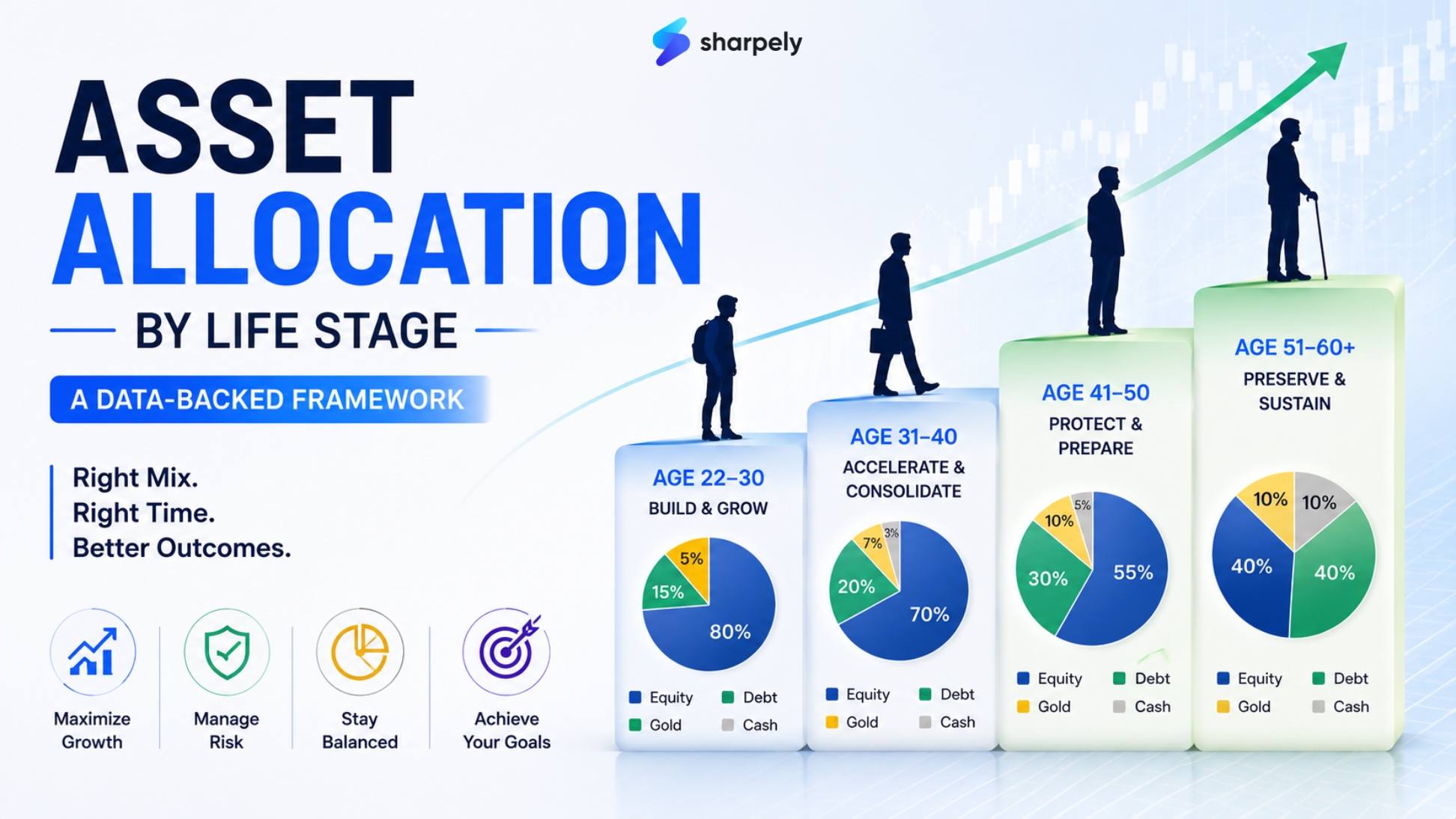
The most important investment decision you will make is not which stock to buy or which mutual fund to pick. It is how to divide your money across asset classes: Equity, debt, gold, and cash at every stage of your financial life.
This decision is called asset allocation, and decades of global and Indian market data consistently show that it accounts for a larger proportion of long-term portfolio outcomes than security selection or market timing. Getting the allocation right and adjusting it as your life circumstances change is the foundation on which everything else is built.
This article provides a framework for asset allocation across four life stages, grounded in historical return data for Indian asset classes and the financial logic that underlies each allocation decision. The framework is not a rigid prescription; it is a starting point that every investor needs to adjust for their own income stability, dependents, risk tolerance, and specific financial goals.
Why Asset Allocation Is the Foundation: Not an Afterthought
A landmark 1986 study by Brinson, Hood, and Beebower, subsequently replicated across markets and time periods, found that asset allocation explains over 90% of the variability in a portfolio’s long-term returns. Not stock selection. Not market timing. The percentage split between equities, bonds, and other asset classes is the primary driver of what your portfolio does over decades.
The Indian data is equally clear on why getting this right matters. The long-term return differential between asset classes is substantial:
| Asset Class | Approx. Long-Term Historical Return (India) | Volatility | Role in Portfolio |
| Equity (Nifty 500 ~20Y) | ~11–13% CAGR | High. Can fall 40-60% in a bear market | Primary wealth creation engine |
| Debt (G-Sec / AAA bonds) | ~6–8% CAGR | Low. Limited price risk if held to maturity | Capital preservation and income |
| Gold | ~10–11% CAGR (20Y in INR) | Moderate. Crisis hedge, currency hedge | Portfolio insurance and diversifier |
| Liquid / Cash Equivalents | ~5–6% (savings / liquid funds) | Negligible | Emergency fund and short-term needs |
The equity-debt return gap of 6–8 percentage points per year sounds modest. But compounded over 20–30 years, it is the difference between retiring comfortably and falling short. A ₹10 lakh investment compounding at 7% over 25 years grows to ₹54 lakh. The same amount compounding at 13% grows to ₹2.1 crore, nearly four times as much.
This is why asset allocation decisions made in your 20s and 30s have consequences that stretch into your 60s. And it is why adjusting the allocation correctly as you age, shifting from growth to preservation, is not a minor administrative task but a fundamental financial decision.
The Framework: What Changes as You Age and Why
Three variables drive how asset allocation should change across life stages:
Time horizon: The longer your investment horizon, the more equity risk you can absorb, because time smooths out short-term volatility. A 25-year-old who sees their equity portfolio fall 40% has 30+ years for it to recover and compound. A 60-year-old in the same situation does not.
Income stability and savings capacity: Early in a career, income is typically lower but growing. Savings rates are modest. As income grows through the 30s and 40s, the ability to invest more and to absorb short-term portfolio losses without needing to sell increases substantially.
Financial responsibilities: Dependents, loans, near-term financial goals (home purchase, children’s education) all create obligations that must be funded from the portfolio, which changes what the portfolio can afford to lose in any given year. A portfolio with zero near-term obligations can ride out a bear market. One that needs to fund a child’s college admission in 18 months cannot.
With these three variables in mind, here is how a data-informed framework approaches asset allocation across four distinct life stages.
Life Stage 1: The Foundation Years (Age 22–30)
The Financial Context
This is the phase of career establishment, first salary, early savings habits, and typically few major financial obligations beyond monthly expenses and possibly a student loan. Income is at its lifetime low point but growing. Time horizon for long-term wealth creation is at its maximum, potentially 35+ years before retirement.
The Allocation Logic
With maximum time horizon and relatively low financial obligations, this is the life stage where the portfolio can absorb maximum risk and should. Equity should dominate, and within equity, the allocation can lean toward mid and small caps where the long-term return potential is highest, even at the cost of short-term volatility. A 30-40% correction in a mid-cap portfolio at age 25 is uncomfortable but recoverable; the same correction at 58 is potentially catastrophic.
Gold serves as a crisis hedge and currency hedge, particularly relevant for Indian investors given the rupee’s long-term depreciation trajectory and gold’s historical role as a portfolio stabiliser during equity market stress. A 10% allocation is standard.
Debt allocation is intentionally low at this stage, but not zero. The emergency fund is the priority debt-equivalent: 6 months of expenses in a liquid fund or savings account, which is separate from the investment portfolio. Within the investment portfolio itself, debt allocation can be kept minimal.
| Asset Class | Recommended Allocation | Rationale |
| Equity (large + mid + small cap) | 75–80% | Maximum time horizon allows maximum growth orientation. Include mid and small cap for higher long-term return potential. |
| Gold | 10% | Portfolio insurance and rupee hedge. Sovereign Gold Bonds (SGBs) preferred; earn 2.5% interest plus price appreciation. |
| Debt | 10–15% | Low allocation at this stage. Short-duration funds or liquid funds for near-term goals only. Emergency fund is separate. |
The Data Behind the Equity Tilt
Historical Nifty 500 data shows that over any 10-year rolling period since 2000, the probability of positive returns has been over 95%. Over 15-year periods, it approaches 100%. At age 25, you have five or six such 10-year periods ahead of you before retirement. The equity risk at this stage is largely illusory; what feels like risk in the short term is simply noise in a very long-term compounding story.
The one genuine risk is behavioural: selling equity during a sharp drawdown out of panic, which converts a temporary loss into a permanent one. This is why starting SIPs early and automating contributions is more valuable than almost any other financial decision in this life stage — it removes the emotional decision-making that destroys long-term returns.
Life Stage 2: The Accumulation Years (Age 30–45)
The Financial Context
This is the highest-stakes period of wealth building. Income is typically growing strongly. Savings capacity is at its peak relative to earlier life stages. But financial obligations are also at their highest: home loans, children’s education planning, aging parents, insurance needs, and potentially a growing lifestyle cost base all compete with investment capacity.
The time horizon is still long, 20 to 30 years to retirement, but it has contracted meaningfully from the previous stage. And the portfolio is now large enough that a 40% correction represents a material, not just psychological, setback.
The Allocation Logic
Equity remains the dominant allocation, but the mix within equity shifts toward quality and balance. The early-30s investor can still hold significant mid and small-cap exposure. By the mid-40s, the equity allocation should gradually shift toward larger, more stable businesses with less cyclical earnings.
Debt allocation begins to build purposefully in this stage, not as a defensive move but as a goal-specific allocation. Home purchases require down payment planning in debt instruments. Children’s education costs that are 8-10 years away can be held partly in hybrid or balanced funds. The debt allocation serves specific near-term and medium-term goals rather than simply acting as portfolio ballast.
Gold continues at 10–15%, with Sovereign Gold Bonds as the preferred vehicle for investors with a multi-year horizon; they earn 2.5% annual interest on top of gold price appreciation, making them significantly more efficient than physical gold or gold ETFs for long-term holdings.
| Asset Class | Early 30s (30–35) | Late 30s–Mid 40s (35–45) | Rationale |
| Equity | 70–75% | 60–70% | Gradual shift from aggressive growth toward quality. Reduce mid/small cap concentration as portfolio grows larger. |
| Debt | 15–20% | 20–25% | Goal-specific: home down payment planning, education corpus building. Mix of PPF, debt mutual funds, and SGBs. |
| Gold | 10% | 10–15% | Maintain as portfolio insurance. SGBs preferred for long-horizon investors. |
| Real Estate | — | Consider | Home purchase may be appropriate if income stability allows EMI comfort. Not as investment; as lifestyle asset. |
The SIP Power in This Stage
The accumulation years are where the compounding math becomes viscerally real. An investor who starts a ₹20,000 monthly SIP in equity at age 30 and maintains it for 15 years, through market cycles, corrections, and recoveries, at a 12% annualised return accumulates approximately ₹1 crore by age 45. The same investor who starts at 35 with the same contribution accumulates approximately ₹50 lakh at 45, half as much, with only five fewer years of investment.
The data makes the case clearly: time in the market, not timing the market, is the primary driver of wealth creation in this stage. The investor’s job is to maximise the savings rate, automate the investments, and resist the temptation to stop SIPs during market corrections, which are precisely when the cheapest units are being accumulated.
Life Stage 3: The Pre-Retirement Years (Age 45–55)
The Financial Context
This stage is defined by three simultaneous pressures: the portfolio is at its largest and therefore most sensitive to large drawdowns, the time horizon to retirement has shortened to 10–15 years, and major financial obligations, children’s education completion, and loan repayments, may be winding down. Peak income is typically reached in this stage.
The twin priorities of this phase are capital preservation alongside continued growth. The portfolio cannot afford to take maximum equity risk, but it also cannot afford to move entirely into low-return debt instruments, because 10–15 years of inflation at 5–6% will substantially erode the real value of a pure debt portfolio.
The Allocation Logic
This is the stage where the gradual de-risking of the portfolio becomes a deliberate, systematic process rather than a response to market conditions. Equity allocation reduces from 60-70% of the accumulation years toward 45-55%, with the equity portion itself shifting increasingly toward large-cap, dividend-paying, and lower-volatility businesses.
Debt allocation builds substantially, but the type of debt instruments changes. This is the stage where PPF (if still within the 15-year window), debt mutual funds with longer duration, and Sovereign Gold Bonds maturing near retirement become the appropriate instruments. Tax efficiency matters more now; debt mutual funds held for more than three years attract indexation benefits, making them significantly more efficient than FDs for investors in higher tax brackets.
A retirement corpus plan should be formalised in this stage: defining the target corpus, calculating the annual withdrawal needed in retirement, and building the glide path toward the debt-heavy allocation appropriate for retirement begins here.
| Asset Class | Recommended Allocation | Rationale |
| Equity | 45–55% | Still needed for real return generation above inflation. Shift within equity toward large-cap, dividend-paying, low-beta stocks. Reduce mid/small cap significantly. |
| Debt | 30–40% | PPF, debt mutual funds (3Y+ for indexation), and corporate bonds. Begin building the debt-heavy retirement corpus. |
| Gold | 10–15% | Maintain or slightly increase. Sovereign Gold Bonds maturing in 5–8 years are appropriate here. |
| Cash / Liquid | 5% | Begin building a dedicated liquidity buffer, 1-2 years of post-retirement expenses in liquid instruments. |
The Sequence of Returns Risk
This stage introduces a concept called sequence of returns risk, the risk that a large market downturn in the years immediately before or after retirement can permanently impair the portfolio, even if long-term average returns recover. An investor who retires during a 40% bear market and begins withdrawing from their portfolio at depressed prices is selling units at low prices, reducing the units available to benefit from the eventual recovery.
This is the primary mathematical reason for de-risking the portfolio in the pre-retirement years. The reduction in equity is not about avoiding volatility for its own sake; it is about reducing the sequence of returns risk during the years when the portfolio is most vulnerable to a bad sequence.
Life Stage 4: Retirement and Beyond (Age 55+)
The Financial Context
The retirement phase inverts the investment logic of all previous stages. The investor transitions from accumulation to distribution; the portfolio now needs to generate income and survive withdrawals rather than grow at maximum rate. The time horizon, while still potentially 20–30 years for a healthy 60-year-old, is finite and known. Capital preservation becomes primary; growth becomes secondary.
In India, retirement planning has additional complexity: limited access to inflation-indexed annuities, family financial obligations that can extend into retirement (supporting children’s milestones, medical costs for aging parents), and significant longevity risk, the risk of outliving one’s assets- given improving life expectancy data in urban India.
The Allocation Logic
The conventional rule of thumb: Hold your age in debt (so a 60-year-old holds 60% debt), is too simplistic for the Indian context. Inflation is the primary adversary in retirement. Indian CPI inflation has averaged 5–6% over the past decade. A purely debt portfolio returning 6–7% post-tax generates near-zero real returns. Over a 25-year retirement, this is a recipe for running out of money.
The Indian retirement portfolio needs a meaningful equity allocation, 30–40% even in early retirement, to maintain the real purchasing power of the corpus. This equity allocation should be in large-cap, low-volatility, dividend-paying stocks and equity funds that generate income alongside appreciation.
The bucket strategy is the most practical framework for managing this balance:
Bucket 1 — Immediate (0-2 years): 1-2 years of annual expenses in liquid funds, savings accounts, and short-term FDs. This bucket is never invested in equity. It funds daily life without needing to sell any investment.
Bucket 2 — Medium-term (2-7 years): 3-5 years of expenses in debt mutual funds, bonds, and SGBs. Generates moderate returns while being refilled periodically from Bucket 3 gains.
Bucket 3 — Long-term (7+ years): Equity and gold allocation. This bucket is not touched for at least 7 years, giving it enough time to recover from any market cycle. Returns from this bucket periodically refill Bucket 2.
| Bucket | Allocation | Instruments | Purpose |
| Bucket 1 (0-2 yrs) | 15–20% | Liquid funds, savings accounts, short FDs | Immediate income, never touches equity |
| Bucket 2 (2-7 yrs) | 40–50% | Debt mutual funds, bonds, SGBs, Senior Citizen Savings Scheme | Medium-term income, refilled by Bucket 3 gains |
| Bucket 3 (7+ yrs) | 30–40% | Large-cap equity funds, dividend-paying stocks, balanced advantage funds | Long-term real return generation and inflation protection |
The Senior Citizen Savings Scheme and PMVVY
For investors above 60, the Senior Citizen Savings Scheme (SCSS), offering 8.2% per annum, payable quarterly, government-backed, with a ₹30 lakh individual cap, is among the highest-returning low-risk instruments available in India. It should be a standard component of Bucket 2 for investors who qualify. The Pradhan Mantri Vaya Vandana Yojana (PMVVY) offers similar benefits through LIC with pension-like regular payments. Both are significantly more efficient than bank FDs for senior investors in lower tax brackets.
Five Principles That Apply Across Every Life Stage
1. Emergency fund first, investment second. At every life stage, maintaining 6 months of expenses in immediately accessible liquid instruments is non-negotiable before any investment. This fund should not be counted as part of the investment portfolio. It is insurance against income disruption and prevents the catastrophic mistake of selling long-term investments at a loss to meet short-term needs.
2. Insurance before investment, always. Adequate term life cover (10–15x annual income) and health insurance (minimum ₹10–15 lakh family floater, higher in metro cities) must be in place before building any investment portfolio. An uninsured health emergency or premature death will destroy a portfolio faster than any market crash.
3. Tax efficiency is a return. ELSS funds (Section 80C, 1.5 lakh deduction), NPS (additional ₹50,000 deduction under Section 80CCD(1B)), PPF (EEE status, exempt on investment, growth, and withdrawal), and SGBs (no capital gains tax on RBI-issued bonds held to maturity) are instruments where the tax benefit is itself a return. Optimising for tax efficiency adds 1-2% to effective annual returns without taking additional risk.
4. Rebalance annually, not reactively. If equity markets rally strongly and your equity allocation drifts from 65% to 78%, rebalancing back to 65% by selling equity and buying debt is not market timing; it is portfolio discipline. Annual rebalancing forces the portfolio to systematically sell what has become expensive and buy what has become cheap. It is among the simplest and most evidence-backed return enhancement strategies available to retail investors.
5. The allocation is the strategy. Most investors spend disproportionate time on security selection, which fund to pick, which stock to buy, and almost no time reviewing whether their overall asset allocation still matches their life stage, risk tolerance, and financial goals. A review of the overall allocation once a year is more valuable than reviewing individual fund selections monthly. The asset allocation decision is the strategy. Everything else is execution.
The Life Stage Framework at a Glance
| Life Stage | Age | Equity | Debt | Gold | Key Priority |
| Foundation Years | 22–30 | 75–80% | 10–15% | 10% | Start early, maximise SIPs, build emergency fund |
| Early Accumulation | 30–35 | 70–75% | 15–20% | 10% | Grow savings rate, begin goal-specific debt allocation |
| Peak Accumulation | 35–45 | 60–70% | 20–25% | 10–15% | Maximise corpus growth, begin pre-retirement planning |
| Pre-Retirement | 45–55 | 45–55% | 30–40% | 10–15% | Systematic de-risking, retire debt, formalise retirement plan |
| Early Retirement | 55–65 | 30–40% | 45–50% | 10–15% | Bucket strategy, SCSS/PMVVY, manage sequence risk |
| Late Retirement | 65+ | 20–30% | 55–65% | 10% | Capital preservation, estate planning, legacy |
The Framework Is a Starting Point, Not a Formula
The allocations in this framework are informed by historical data and financial planning principles, but they are not a formula that applies identically to every investor. Two 35-year-olds with the same income can have very different appropriate allocations depending on the stability of that income, their dependents, their existing assets, their risk tolerance, and their specific financial goals.
What this framework provides is the structure for the conversation you need to have with yourself, or with a financial advisor, at each life stage. The questions are always the same: What is my time horizon? What financial obligations must I fund in the next 1-3 years? Can my portfolio afford a 40% drawdown without forcing me to sell? Am I still on track for my retirement corpus target?
The investors who build wealth systematically across a lifetime are not the ones who made the best stock picks or timed the market correctly. They are the ones who got the asset allocation approximately right at each life stage, rebalanced it annually, maintained their contributions through market cycles, and did not let short-term market noise disrupt a long-term plan.
The allocation is the strategy. Build it deliberately, review it annually, and let time do the compounding.
Check your current portfolio allocation and health on sharpely WealthView.