
When Indo-MIM listed on the BSE and NSE on July 30, 2026, it debuted at ₹700, a 44% premium to its IPO price of ₹485. Less than two months later, HDFC Securities initiated coverage with a Buy rating and a target price of ₹1,407, sending the stock into a 10% upper circuit.
Most investors had not heard of metal injection moulding before this IPO. Many still do not fully understand what the company makes, who it sells to, or why a Bengaluru-headquartered manufacturer has two-thirds of its revenue coming from North America and Europe.
This article covers the business from first principles: what MIM technology is, how Indo-MIM’s business model works, what the financials actually show, and the structural growth triggers that are driving institutional interest in this newly listed company.
What Is Metal Injection Moulding, and Why It Matters
Metal injection moulding (MIM) is a precision manufacturing process that combines the design flexibility of plastic injection moulding with the structural strength and properties of forged metal. The process involves mixing fine metal powder with a binder material, injecting the mixture into a mould under high pressure to create complex shapes, then debinding and sintering the part at high temperatures to produce a dense, finished metal component.
The result is a precision metal part with extremely tight tolerances, complex internal geometries, and high strength, produced at scale and at costs that traditional machining or casting cannot match for small, intricate components.
MIM is particularly well suited to components that are:
Small and complex: weighing between 0.1 grams and 200 grams, with geometries that would be expensive or impossible to machine. Think firearm triggers, surgical stapler housings, fuel system components, or satellite brackets.
High volume: MIM tooling is capital-intensive but per-part costs decline sharply at scale. For components produced in the tens or hundreds of thousands, MIM is typically the most cost-effective process available.
Material critical: MIM can work with stainless steel, titanium, cobalt-chromium, nickel alloys, and other advanced materials that are difficult to machine conventionally.
Indo-MIM’s competitive advantage begins here: it has spent over three decades developing the process expertise, in-house metal powder production, tooling capabilities, and quality certifications to serve the world’s most demanding customers across five end markets.
The Business Model: How Indo-MIM Makes Money
Five Technology Platforms, One Integrated Offering
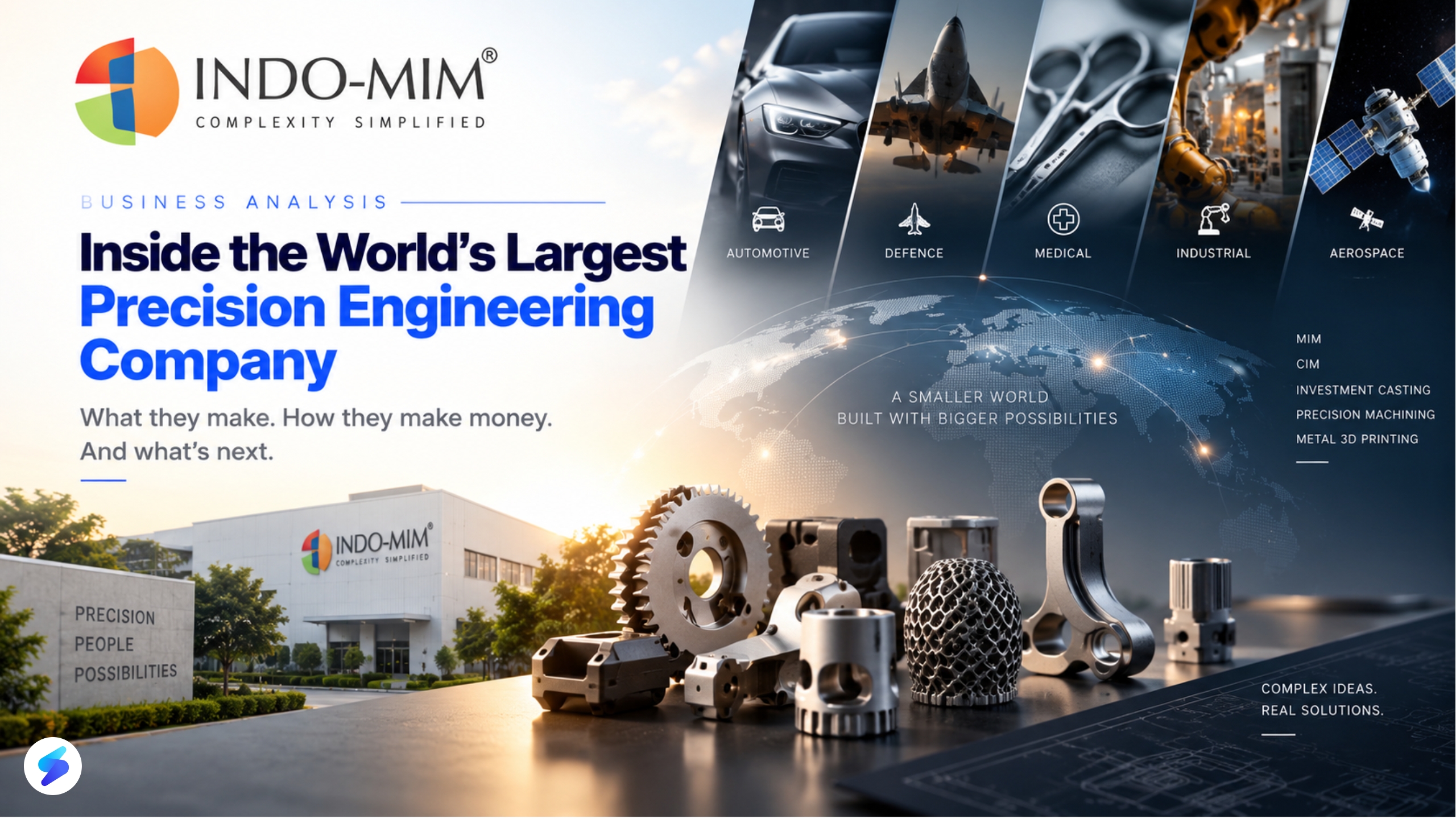
While MIM is the core revenue engine, Indo-MIM operates five distinct manufacturing technologies that together form a complete precision engineering platform:
1. Metal Injection Moulding (MIM): The primary business. Complex, small, high-volume metal components across all end markets.
2. Ceramic Injection Moulding (CIM): Same process applied to ceramic materials, relevant for electronics, medical, and high-temperature industrial applications.
3. Investment Casting: For larger, heavier components that cannot be made by MIM. Particularly relevant for aerospace structural parts, turbine components, and industrial applications.
4. Precision Machining: Secondary processing to achieve ultra-tight tolerances on cast or moulded parts. Adds value rather than being a standalone business.
5. Metal 3D Printing: The newest capability, additive manufacturing for prototyping, low-volume specialty parts, and components with geometries no other process can produce.
The strategic value of this multi-technology stack is that Indo-MIM can act as a single manufacturing partner for complex component requirements. A customer bringing a new product to market does not need to qualify five separate vendors. Indo-MIM selects the right process for each component and delivers from a single relationship. This ‘one-stop advanced manufacturing partner’ positioning is a significant competitive advantage for customers managing complex supply chains.
Revenue Model and Customer Concentration
Indo-MIM sells on a purchase order basis; it does not hold long-term supply contracts with fixed committed volumes. Revenue depends almost entirely on repeat business rather than contractual commitments. Critically, repeat customers contributed approximately 92% of revenue in FY26, a remarkably high figure that speaks to customer stickiness and the difficulty of switching a qualified precision component supplier.
In FY26, the company served over 1,100 customers across 30+ countries and manufactured over 9,000 distinct products. No single end-use segment contributes more than 25% of revenue; the diversification across automotive, defence, medical, consumer, and aerospace is genuine, not cosmetic.
Geography: The US as Primary Market
Indo-MIM is a fundamentally export-oriented business. In FY26, exports accounted for approximately 77% of revenue, down from 88-90% in FY24-25, largely because two new large domestic customers added roughly ₹491 crore in India revenue in FY26. The core geographic breakdown from RHP data:
| Geography | FY26 Revenue (₹ Cr) | % of Revenue |
| North America | 1,831.65 | 43.7% |
| India | 956.01 | 22.8% |
| Europe | 837.29 | 20.0% |
| Rest of World | 456.86 | 10.9% |
| South East Asia | 111.18 | 2.7% |
The US concentration is deliberate. Indo-MIM has built deep relationships with leading US multinational corporations, maintains onsite engineering and manufacturing presence in the US (six of its 15 plants are in the US, with additional facilities in the UK and Mexico), and has embedded itself in the innovation and new product development programmes of its largest customers. This proximity is not just about logistics; it is about being present in the early stages of a customer’s product design, which is where supplier selection decisions are made.
The Financial Picture: FY24 to FY26
Indo-MIM has delivered consistent, compounding growth across the three fiscal years covered in its IPO prospectus.
| Metric | FY24 | FY25 | FY26 | 3Y CAGR |
| Revenue (₹ Cr) | 2,870 | 3,330 | 4,193 | +21% |
| EBITDA (₹ Cr) | 743 | 933 | 1,071 | +20% |
| EBITDA Margin | 25.9% | 28.0% | 25.5% | — |
| PAT (₹ Cr) | 284 | 424 | 534 | +37% |
| PAT Margin | 9.9% | 12.7% | 12.7% | — |
| ROE | 13.8% | 19.3% | 21.3% | — |
| ROCE | 19.6% | 23.5% | 26.6% | — |
| Debt/Equity | 0.53x | 0.57x | 0.39x | — |
Several things in this financial picture are worth highlighting:
Revenue growth is accelerating: FY25 growth was ~16%, FY26 growth was ~26%. The acceleration is partly driven by the two new large domestic customers, but export revenue also grew, suggesting it is not simply India-driven.
PAT is growing faster than revenue: PAT has compounded at ~37% over three years versus ~21% for revenue. This reflects operating leverage, as revenue scales, fixed manufacturing costs are absorbed more efficiently, and the higher-margin domestic customers added in FY26 improved the mix.
EBITDA margin moderated in FY26: From 28% in FY25 to 25.5% in FY26. This is worth monitoring; the RHP notes that material costs per part climbed 74% over FY24-FY26, even as revenue per part grew only 30%. The margin compression was absorbed by the volume increase, but if input cost inflation continues, margins may remain under pressure.
Balance sheet is improving: Debt/equity fell from 0.57x to 0.39x in FY26. The IPO’s ₹500 crore fresh issue proceeds included ~₹400 crore earmarked for debt repayment, which will improve the already-healthy balance sheet further. ROCE of 26.6% is among the strongest in the Indian capital goods and precision engineering universe.
Unit economics are improving: Revenue per part manufactured rose from ₹115 in FY24 to ₹150 in FY26, a 30% increase. EBITDA per part improved from ₹30 to ₹38. The company is making more money per component even as the product mix evolves toward higher-value applications.
The Competitive Moat: Why This Business Is Difficult to Replicate
Indo-MIM’s competitive position is not primarily about cost or capacity; it is about the accumulated barriers to entry that have been built over three decades:
1. Six-Year Global Market Share Leadership
According to a Frost & Sullivan report commissioned for the IPO offer, Indo-MIM has held its position as the world’s largest MIM manufacturer by revenue for six consecutive years, with approximately 7% global market share in CY25. In a fragmented global MIM market, holding 7% share for six years while growing at 20%+ annually is a clear signal of durable competitive advantage.
2. Vertical Integration From Powder to Finished Part
Most MIM manufacturers source metal powder from third parties. Indo-MIM produces its own metal powder in-house, giving it control over a critical raw material, reducing supply chain risk, improving quality consistency, and creating a cost advantage that competitors relying on external powder suppliers cannot easily replicate.
3. Customer Integration and Qualification Barriers
Winning a precision component program requires engineering collaboration with the customer, materials qualification, tooling development, process validation, and quality certifications. This process can take 12-24 months. Once a supplier is qualified and embedded in a customer’s product, replacing it involves repeating this entire process, with all associated time, cost, and supply chain risk. The 92% repeat revenue figure is the financial expression of these switching costs.
4. Multi-Technology Capability as a Strategic Lock-In
As customers expand their product ranges, they naturally require components that span different manufacturing processes. A customer that has qualified Indo-MIM for MIM components and then needs investment casting or precision machined parts faces a simpler and lower-risk path to qualifying Indo-MIM for those additional processes than qualifying a new vendor from scratch. The multi-technology platform compounds the stickiness of existing relationships.
5. Onsite Presence in Key Markets
Having manufacturing facilities in the US (six plants), UK (two plants), and Mexico (one plant), alongside six Indian plants, means Indo-MIM can serve US and European customers with local supply chain proximity, reduced lead times, and direct engineering support. This is particularly important for defence and aerospace customers where domestic sourcing preferences and security requirements can favour US or allied-nation manufacturing. Competitors operating only from India face these barriers at the market access level.
The Growth Triggers: What Analysts Are Watching
1. The Ex-China Supply Chain Shift
The most significant structural tailwind for Indo-MIM is the accelerating shift of precision component manufacturing away from China, driven by geopolitical risk, tariff escalation, and OEM supply chain diversification mandates. Indo-MIM is positioned as a primary beneficiary because of its scale, its established US manufacturing presence, and its existing relationships with US multinational customers who are actively seeking to reduce China exposure.
Crucially, Indo-MIM’s US manufacturing facilities provide relative insulation from tariff-related disruptions that affect pure importers from India. A component manufactured in San Antonio, Texas, for a US customer does not face the same tariff risk as one shipped from Bengaluru. This distinction matters as US companies evaluate their supply chains under the current trade environment.
2. US Defence Spending and Drone Programmes
HDFC Securities highlights US Department of Defence capital spending, particularly drone programmes, as a near-term growth catalyst. MIM technology is well-suited for the lightweight, complex, precision components used in drone systems, missile guidance, firearm components, and other defence applications. Indo-MIM’s defence revenue currently sits at approximately 10% of its end-market mix by some estimates, but the global defence precision components market where MIM is applicable is growing rapidly alongside rising geopolitical tensions and defence budgets globally.
Notably, Indo-MIM incorporated INDO-MIM Arms Components Pvt. Ltd. in India in FY26, a dedicated domestic defence component entity, suggesting management is actively positioning for the India defence indigenisation opportunity alongside the US defence market.
3. Humanoids, Automation, and Next-Generation Manufacturing
This is the optionality element of the thesis. Humanoid robots require thousands of precision metal components, actuators, joints, fasteners, gearboxes, and structural elements that are exactly the type of components MIM excels at producing. Similarly, the expansion of automation and robotics equipment across manufacturing sectors requires precision-engineered components at scale.
HDFC Securities characterises Indo-MIM as having ‘only scratched the surface’ of its opportunity in next-generation manufacturing applications including humanoids, space components, satellite systems, data centre hardware, and automation equipment. These are markets in early commercial scale-up, but Indo-MIM’s qualification with leading US technology companies means it is positioned to grow with these markets as they scale.
4. Aerospace Recovery and Space
Aerospace is already disproportionately represented in Indo-MIM’s revenue relative to the global MIM market share; aerospace accounts for approximately 12% of company revenue against 2.5% of the global MIM market. This reflects the company’s investment casting capability, which opens the larger structural aerospace component market beyond what pure MIM can serve.
Commercial aerospace is in a sustained multi-year recovery cycle, with Boeing and Airbus backlogs stretching into the early 2030s. At the same time, the new space economy- satellite constellations, launch vehicle components, space habitats- is creating demand for precision components with the same characteristics as aerospace parts: complex geometries, advanced materials, weight-critical design, and stringent quality requirements.
5. Medical Devices: The Most Defensive Growth Driver
Medical devices represent one of the most stable and recurring demand drivers in Indo-MIM’s business. Surgical instruments, orthopaedic implant components, endoscopic tool parts, and drug delivery device components are manufactured in high volumes, require consistent quality, and carry very high switching costs once a supplier is qualified by a medical OEM. This end market provides baseline revenue stability that partially offsets the cyclicality in automotive and consumer goods segments.
6. Capacity Expansion: New Chennai Plant
HDFC Securities notes that capacity addition is the primary constraint on Indo-MIM’s growth, not demand. The company’s annual report confirms manufacturing has begun at a new Chennai plant in FY26, the first capacity addition in India since the existing Bengaluru facilities. This plant adds manufacturing capacity to serve the two new large domestic customers acquired in FY26 and positions the company for additional domestic demand.
The ₹500 crore fresh issue proceeds are being used partly for capacity expansion alongside debt repayment. If the demand from aerospace, defence, humanoids, and data centre programmes scales as expected, the company may need to accelerate capacity addition, making execution of the capex plan the key operational monitorable.
Risks Worth Watching
No long-term supply contracts: Revenue depends on repeat purchase orders. If a major customer reduces purchases or qualifies an alternative supplier, the impact on revenue could be sharp. The 92% repeat rate provides comfort but does not eliminate this risk.
Material cost inflation: Metal powder costs climbed 74% per part over FY24-FY26 while EBITDA per part grew only 27%. If input cost inflation continues to outpace pricing power, EBITDA margins, already down from 28% to 25.5%, could compress further.
US market concentration: North America is 44% of revenue. Any significant slowdown in US manufacturing activity, adverse change in US trade policy that affects allied manufacturers, or loss of major US customers would have an outsized impact on the consolidated business.
Valuation: At the current market price of approximately ₹1,160, Indo-MIM trades at roughly 68x FY27 estimated earnings. HDFC Securities values it at 54x September 2028 estimated EPS to arrive at ₹1,407, meaning the stock is pricing in significant earnings growth over the next two years. Any miss on earnings or delay in capacity addition could result in meaningful de-rating.
Emerging application optionality is optionality, not certainty: The humanoid, space, and data centre themes are compelling growth narratives but remain early-stage demand. The investment case for those themes requires years of commercial development before they become meaningful contributors to Indo-MIM’s revenue.
The Summary View
Indo-MIM is not a story most Indian retail investors are familiar with; precision manufacturing is not a glamorous sector, and MIM is not a household term. But the business behind the IPO is genuinely world-class: the largest MIM manufacturer on the planet, with six years of market share leadership, 92% revenue from repeat customers, a multi-technology platform that competitors would take decades to replicate, and a 26%+ ROCE that puts it in the top tier of Indian manufacturing companies by capital efficiency.
The growth triggers are real and structural: ex-China supply chain diversification, US defence spending, the precision component requirements of humanoids and space technology, aerospace recovery, and medical device stability. HDFC Securities’ initiation with a Buy and ₹1,407 target reflects a thesis that Indo-MIM is at the early stages of monetising a much larger opportunity than its current revenue base suggests.
The risks are also real: no supply contracts, material cost pressure, US concentration, and a valuation that prices in a significant amount of the growth story. For investors considering this company, the critical questions are: how quickly will the next-generation demand (humanoids, defence drones, space) translate into actual purchase orders? And can management execute the capacity expansion fast enough to capture it?
Both questions point to the same monitorable: quarterly order inflows and capacity utilisation data in the first few quarters post-listing. The story is compelling. Whether the current price adequately reflects the execution risk that remains is the judgement each investor must make independently.
Data Sources: Indo-MIM Red Herring Prospectus (RHP) filed with SEBI, FY26 Annual Report published by INDO-MIM Ltd (NSE: INDOMIM | BSE: 543358), HDFC Securities Initiating Coverage Report dated September 18, 2026, Frost & Sullivan market research report commissioned for the Indo-MIM IPO offer, and publicly available BSE/NSE regulatory filings.