

Every few years, a new wave of thematic mutual funds arrives in India: Defence funds, AI and Technology funds, Manufacturing funds, Green Energy funds, EV funds. Each arrives at a moment when the underlying theme is generating headlines and enthusiasm. Each attracts significant inflows from investors who want exposure to what looks like an obvious, irreversible trend.
Some of these themes deliver. Others disappoint, not because the trend was wrong, but because the fund was bought at the wrong time, held for the wrong reasons, or allocated too heavily relative to the investor’s overall portfolio.
Thematic and sectoral mutual funds are among the highest-potential and highest-risk categories in the Indian mutual fund universe. They can be genuinely useful portfolio tools, or genuinely harmful ones, depending entirely on how they are used. This article explains the difference between the two types, when they make sense, and what an investor needs to understand before using them.
Sectoral Funds vs Thematic Funds: The Distinction That Matters
SEBI treats sectoral and thematic funds as a single category; both must invest a minimum of 80% of assets in stocks related to the sector or theme. But they are meaningfully different in terms of concentration, flexibility, and risk profile.
Sectoral Funds
A sectoral fund invests in companies within a single, defined industry sector; Banking, IT, Pharma, FMCG, Infrastructure, Auto, and so on. The investable universe is narrow and precise. A Banking sectoral fund holds bank stocks and financial services companies. A Pharma fund holds pharmaceutical manufacturers, API producers, and healthcare companies. There is little room for the fund manager to step outside the defined sector even if conditions in that sector deteriorate. Here is the example of tech sector funds.
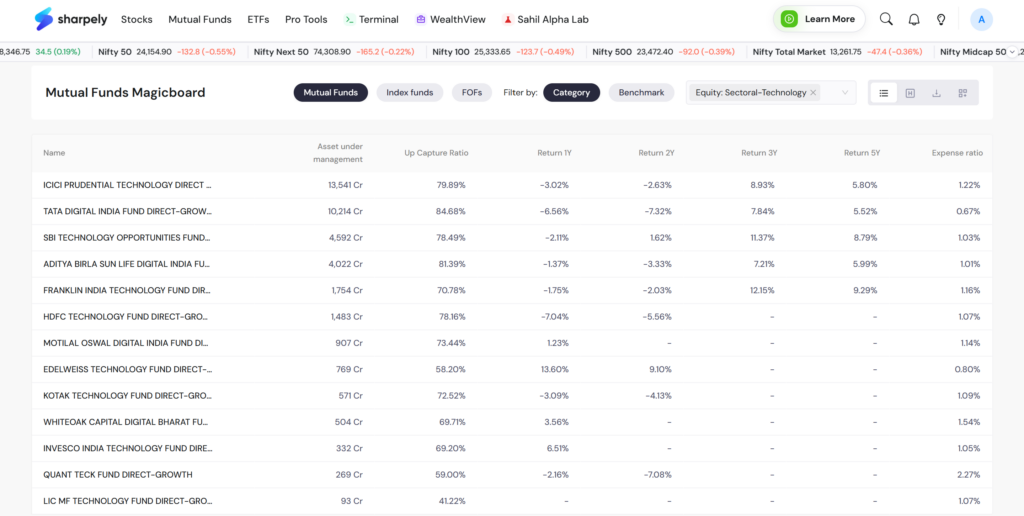
This rigidity is both the product’s strength and its risk. When Banking is in a bull phase, a Banking fund captures that move with near-total concentration. When Banking underperforms for a prolonged period, as it did in certain stretches post-2018, the fund has no mechanism to reduce exposure or rotate out. You are fully committed to the sector’s cycle.
Thematic Funds
A thematic fund invests in companies that benefit from a broad, cross-sector economic theme, rather than a single industry. A Manufacturing theme fund might hold companies across Capital Goods, Auto Ancillaries, Chemicals, Packaging, and Defence, all of which benefit from India’s manufacturing expansion thesis, even though they span multiple sectors. A Digital India theme might hold IT companies, payment infrastructure firms, telecom companies, and digital media businesses. Below is an example of infra funds.
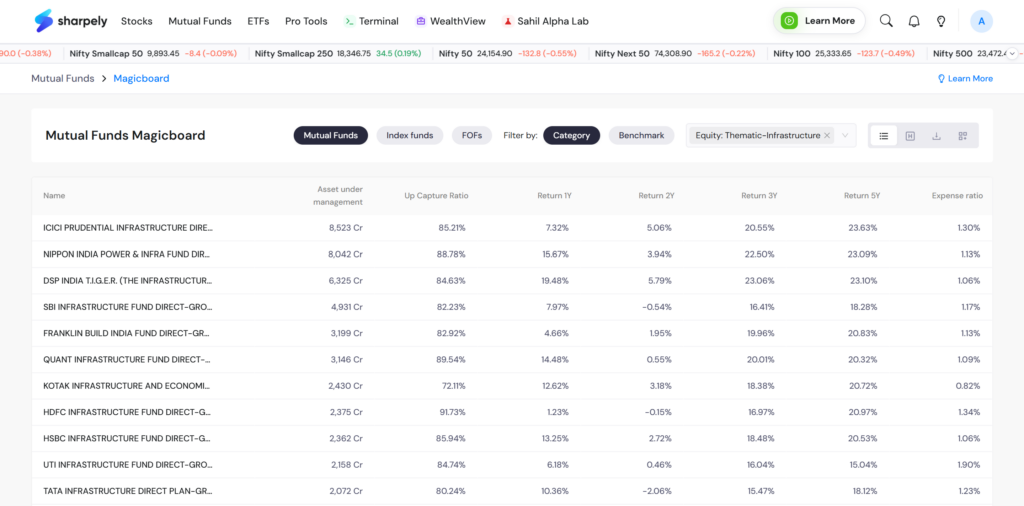
The broader investable universe gives the thematic fund manager more flexibility; they can own the best expressions of the theme across sectors rather than being constrained to one. This flexibility reduces some of the single-sector concentration risk while maintaining the core thematic exposure. However, it also means the fund’s returns depend more heavily on the manager’s skill in identifying which companies truly benefit from the theme, a harder analytical task than simply owning all companies in a defined sector.
| Dimension | Sectoral Fund | Thematic Fund |
| SEBI minimum allocation | 80% in defined sector | 80% in theme-related stocks (cross-sector) |
| Investable universe | Narrow. One industry | Broader. Multiple sectors connected by a theme |
| Manager flexibility | Low. constrained to sector | Higher. Can choose best theme expressions across sectors |
| Concentration risk | Very high. Single sector | High. But spread across multiple sectors |
| Entry timing sensitivity | Extremely high | High. But slightly less than pure sectoral |
| Examples | Nifty Bank Fund, Pharma Fund, IT Fund | Defence Fund, ESG Fund, Manufacturing Fund, EV Fund |
Why Investors Buy Them, and Where They Go Wrong
The appeal is straightforward. When a sector or theme is outperforming and making headlines, the argument for buying a concentrated fund feels compelling. Defence funds delivered exceptional returns during India’s defence indigenisation push. Infrastructure funds rode the government capex supercycle. Pharma funds outperformed during the COVID period when healthcare demand surged globally.
These are real returns from real themes. The problem is rarely the theme. The problem is almost always the timing and the allocation size.
The Timing Problem
Thematic and sectoral funds attract the most inflows after the theme has already delivered strong returns, which is precisely when the risk-reward is least favourable. An investor who bought a Defence fund in 2021 when the theme was in its early stages captured the bulk of the multi-year re-rating. An investor who bought a Defence fund in 2024 after it had already delivered 150%+ returns was buying a fully valued, widely-followed theme with much more limited upside and significantly more downside risk if the theme disappointed.
This is the narrative trap, the human tendency to extrapolate recent strong performance into the future, particularly when there is a compelling story behind it. The story about India’s defence indigenisation, manufacturing push, or digital economy is genuinely true and long-term. But the stock market prices these themes faster than the underlying fundamentals can justify, particularly when institutional and retail money chases the same funds simultaneously.
The Allocation Problem
The second common mistake is size. Thematic and sectoral funds are high-conviction, concentrated instruments. They are designed to be held as satellite positions, supplementing a core diversified portfolio, not as primary holdings. An investor who puts 40% of their equity portfolio into a single sectoral fund has, in effect, built a concentrated sector bet rather than an equity portfolio. When that sector underperforms for two or three years, which every sector does, eventually, the portfolio impact is severe.
A widely used framework among financial planners: thematic and sectoral funds should typically not exceed 10-15% of the total equity portfolio, and even that requires conviction in both the theme and the entry timing. For most investors, 5-10% in any single theme is more appropriate.
When Thematic and Sectoral Funds Actually Make Sense
Used correctly, thematic and sectoral funds serve a specific and legitimate purpose. Here are the conditions under which they are genuinely useful rather than speculative.
When You Have a Long-Term Structural View on a Theme
The best thematic fund investments are made when an investor has a multi-year conviction on a structural change that is early in its development, not when the theme is already widely discussed and priced in. India’s manufacturing re-shoring from China, the formalisation of the economy, the build-out of physical infrastructure, the rise of domestic defence production- these are genuinely long-duration themes with years of runway.
The key question to ask before investing in any thematic fund: is this theme early or late? A theme that has been running for three years and has already delivered 100%+ returns to early investors is a very different risk-reward proposition from a theme in its first innings. The underlying story may be equally compelling in both cases; the valuation is not!
When a Sector Is in a Confirmed Recovery with Improving Fundamentals
Sectoral funds can be genuinely useful at the early stages of a sector recovery cycle, when fundamentals are turning positive, institutional money is beginning to flow in, and valuations have not yet re-rated to reflect the improving outlook. This is where sector rotation analysis becomes directly relevant to thematic fund investing.
A sector that is moving from the weakening quadrant to the improving quadrant on an RRG chart, with broad breadth confirmed by the sector heatmap and fundamental evidence of earnings recovery in the quarterly results data, presents a much more favourable entry point for a sectoral fund than one already deep in the Leading quadrant with extended valuations. The analytical tools and the fundamental framework should inform the timing, not just the narrative.
As a Portfolio Complement, Not a Core Holding
The most appropriate use of thematic and sectoral funds is as a satellite allocation that expresses a specific view on top of a diversified core portfolio. If your core portfolio is a combination of large-cap, flexi-cap, and mid-cap diversified equity funds, covering the broad market systematically, a 5-10% allocation to a Defence or Infrastructure theme represents an additional, intentional bet on that specific part of the market without making the entire portfolio dependent on that bet being right.
This structure means that if the theme delivers, the satellite allocation amplifies returns beyond those of the diversified core. If the theme disappoints, the core portfolio limits the damage. The thematic fund adds upside potential without creating existential portfolio risk.
When You Have a Clear Exit Framework
Most investors who lose money in thematic and sectoral funds do so not because they chose the wrong theme — but because they had no plan for when to exit. They bought on the narrative and held as the narrative faded, watching the fund’s outperformance reverse without a clear trigger for reassessment.
Before buying any thematic or sectoral fund, define your exit framework explicitly:
Time-based: ‘I will review this allocation in 18-24 months and reduce if the theme has not shown fundamental evidence of growth materialising.’
Valuation-based: ‘If the P/E of this sectoral index exceeds its 10-year average by more than 30%, I will reduce my position.’
Momentum-based: ‘If the sector moves from Leading to Weakening on the RRG and holds there for more than 4-6 weeks, I will reassess.’
Any one of these frameworks is better than no framework. The investors who preserve capital in thematic funds are the ones who entered with a thesis and exit when the thesis, not just the price, changes.
When to Avoid Thematic and Sectoral Funds
Being direct about when these funds are the wrong choice is as important as explaining when they are right.
Avoid when the theme is already on the front page of every financial newspaper. By the time a theme is generating widespread mainstream coverage, the institutional money has already arrived. The easy money in the theme has already been made. What remains is the risk of a crowded trade unwinding, which can be rapid and painful.
Avoid as a substitute for a diversified core portfolio. No thematic fund, however compelling the underlying story, should replace a diversified equity portfolio. The concentration risk is too high and the cycle dependence too severe. Build the core first, always.
Avoid if your investment horizon is less than five years. Sectoral and thematic cycles are long. A sector can underperform the broader market for three to four consecutive years even when the long-term story is intact. An investor who cannot hold through multiple years of underperformance should not be in these funds.
Avoid if you cannot monitor the investment actively. Unlike a diversified equity fund, which a patient investor can essentially ignore for years, a thematic fund requires active monitoring of whether the theme is still on track. Quarterly earnings data for companies in the fund, government policy developments relevant to the theme, and sector-level momentum signals all need to be tracked. A set-and-forget approach is not appropriate for thematic funds.
How to Track Thematic Funds the Right Way
For investors already holding thematic or sectoral funds, or considering doing so, a systematic approach to monitoring is more valuable than a one-time selection decision.
Track sector-level earnings growth quarterly. The results season tracker on sharpely shows median sales and profit growth by sector and industry group, updated each quarter as company results come in. You can do this easily using the earnings tracker. If the sector underlying your thematic fund is showing decelerating earnings growth for two or more consecutive quarters, that is a fundamental signal worth taking seriously — independent of what the fund’s NAV is doing.
Monitor sector momentum via the RRG. sharpely’s RRG under Pro Tools shows which sectors are in the Leading, Improving, Weakening, or Lagging quadrants weekly. A sector fund whose underlying sector is moving from Leading to Weakening, with a tail pointing toward Lagging, is a portfolio worth reassessing. The RRG gives you this signal in real time rather than waiting for a quarterly report to confirm what the price has already been telling you.
Check the fund’s portfolio overlap with your existing holdings. Thematic funds, particularly manufacturing, infrastructure, and capital goods themes, can have significant overlap with diversified mid-cap and multi-cap funds that already hold many of the same names. Before adding a thematic fund, check the overlap via sharpely’s WealthView to understand whether you are genuinely adding a new exposure or simply concentrating an existing one under a different label.
India-Specific Themes Shaping the Current Thematic Fund Landscape
Understanding the current Indian thematic fund universe in the context of where each theme sits in its cycle is more useful than a generic list of fund names. Here are the themes that have drawn significant AUM in recent years and the questions worth asking about each:
Defence and Aerospace: India’s indigenisation push is a genuine, multi-decade structural story supported by government policy (defence FDI liberalisation, export targets, DRDO commercialisation). The theme has already delivered significant returns to early investors. The question for new investors is not whether the story is real; it is whether the valuation already reflects the next five years of growth.
Infrastructure and Capital Goods: Government-led capex on roads, railways, ports, and power infrastructure has been one of the most durable themes of the current economic cycle. This theme benefits from strong order book visibility; most large infrastructure companies have multi-year order books that provide revenue certainty. The risk is execution, government spending continuity post-election cycles, and commodity price volatility in input costs.
Manufacturing and PLI-linked Themes: India’s Production Linked Incentive (PLI) scheme across electronics, pharmaceuticals, textiles, solar, and auto components represents a genuine policy-driven manufacturing push. The beneficiary universe is broad, spanning multiple sectors, which makes manufacturing a better fit for a thematic fund (cross-sector) than a sectoral one.
PSU and CPSE Themes: Public Sector Undertaking focused funds invest in government-owned companies across banking, energy, defence, and utilities. These funds benefit from policy tailwinds, government capex, divestment-related re-ratings, and strong dividend yields, but carry regulatory and political risk that private sector funds do not.
ESG and Sustainability Themes: ESG (Environmental, Social, Governance) themed funds are still early-stage in India from a mainstream adoption perspective. The investable universe is constrained by the relatively limited number of Indian companies with strong ESG credentials and third-party ESG ratings. This is a theme to watch for the long term rather than a near-term tactical play.
Key Takeaways
Sectoral funds concentrate in one industry; thematic funds express a cross-sector idea. Both require at least 80% allocation to the theme by SEBI mandate. The broader universe of a thematic fund provides slightly more flexibility, but both carry significantly higher concentration risk than diversified equity funds.
The theme being right and the timing being right are two separate questions. Most investors who lose money in thematic funds chose a genuine, ultimately successful theme, and bought it too late, after the narrative was already fully priced in. Valuation and cycle positioning matter as much as the underlying story.
Satellite, not core. Thematic and sectoral funds should typically represent 5-15% of an equity portfolio at most, on top of a diversified core, not instead of one. The concentration risk is too high and the cycle dependence too severe for larger allocations.
Define your exit framework before you invest. Time-based, valuation-based, or momentum-based, any framework is better than none. The investors who preserve capital in thematic funds are those who entered with a thesis and exit when the thesis changes, not when they run out of patience.
Monitor actively or do not invest. Thematic funds require tracking earnings momentum, sector rotation signals, and policy developments related to the theme. A set-and-forget approach appropriate for a diversified equity fund is not appropriate for a sectoral or thematic one.