
Most investors who search for Vijay Kedia’s portfolio are looking for his stock picks. That is the wrong thing to look for.
His stocks change every quarter. His philosophy does not. And his philosophy is what turned a 19-year-old from Kolkata who started investing with borrowed capital into one of India’s most respected equity investors, with a publicly disclosed portfolio worth over ₹1,333 crore across 20 stocks as of the latest regulatory filings.
Kedia has never hidden his framework. He has shared it in interviews, on social media, at investor conferences, and through two decades of publicly documented investment decisions. This article distils what he has said, consistently, across many years, into the core principles that explain both his approach and his results.
The Background Worth Knowing
Vijay Kedia began investing at 19. He started Kedia Securities in 1992. His early years in the market were not marked by immediate success, he has spoken openly about periods of significant losses, wrong calls, and the discipline it took to survive and learn from them.
What makes his story instructive is not the wealth, it is the method. Kedia did not build his portfolio through trading frequency, leverage, or access to privileged information. He built it by identifying small, under-followed businesses early, understanding their management and their market potential deeply, and holding them through multiple market cycles while most other investors lost patience and moved on.
| “One should scout for companies with good management. Find very good management, very honest management, and see the products in which the management is going to grow, going to outperform its peers and the economy. Invest in those companies for the next 10-15 years, and you cannot go wrong.” Vijay Kedia, Business Standard interview |
The SMILE Framework: What It Actually Means
Kedia’s most widely cited contribution to Indian investing is the SMILE framework, a five-part checklist for identifying businesses worth owning for the long term. He introduced it publicly via Twitter in 2019 and has elaborated on it across multiple interviews since.
SMILE stands for:
| Letter | Stands For | What Kedia Actually Means |
| S | Small in Size | Not necessarily low market cap, small market share in a large, growing industry. Room to grow is the key variable, not the current size of the business. |
| M | Medium in Experience | The company and its management have survived at least one business cycle. Not too new to be unproven, not so established that the best growth is behind them. |
| I | Large in Aspiration | Management that thinks and acts big. Kedia looks for promoters with genuine ambition for the business, not those who are content with slow, incremental progress. |
| L | Extra-Large in Market Potential | The total addressable market must be genuinely large, not a niche with a ceiling. The business should have a long runway ahead of it, not just a good current year. |
| E | Excellence in Management | Often summarised within the L, but distinct, Kedia places management quality above all other filters. Honest, capable, owner-operator management is non-negotiable. |
The important nuance on the ‘S’: Kedia has clarified in multiple interviews that he does not require a company to have a small market cap. What he requires is that the company has a small share of a large market, meaning the growth opportunity ahead is disproportionately larger than what the company has already captured. A company can be mid-cap by market cap and still qualify for ‘S’ if its market penetration is genuinely low.
The SMILE framework is not a valuation model. It is a business quality filter, a way of thinking about whether a company has the structural prerequisites for multi-year compounding before you ever look at the price. Kedia’s view, stated consistently, is that great businesses bought at fair prices will outperform average businesses bought at cheap prices over a long enough holding period.
Management Over Everything Else
If SMILE is Kedia’s framework, management quality is its foundation. He returns to this point repeatedly across years of interviews, more than any other single variable.
| “Chase the story behind the stock, not the money on the table.” Vijay Kedia |
What he means by the ‘story’ is: understand what the promoter is trying to build, whether they have the capability to build it, and whether they have the integrity to run the business in shareholders’ interests. Financial metrics are outputs. Management quality is the input. A dishonest or incompetent management can destroy any business irrespective of how good the industry opportunity is.
Kedia’s approach to management assessment is not formulaic. He meets management, reads annual reports carefully, not just for the numbers but for the language and the commitments made and kept, and tracks whether the company does what it says it will do over time. He has described passing on businesses with excellent financials because he was not convinced about the promoter, and backing businesses with modest current financials because the promoter’s quality was exceptional.
His Aegis Logistics investment, made around 2004 at approximately ₹4–5 per share (adjusted for splits), is a widely cited example of this in practice. The business at the time was small, under-followed, and in an unglamorous sector, LPG logistics. What Kedia saw was a promoter-led business with high skin in the game (the Chandaria family held over 60%), a structural India consumption tailwind (LPG demand), and a genuine competitive moat (the only private LPG import terminal at Mumbai port). He held it for years. The stock became one of his most significant wealth creators.
How Kedia Thinks About Market Cycles
Kedia’s views on market cycles are among his most quoted, and most misunderstood. He is neither a perma-bull nor a market timer. His framework for cycles is rooted in a simple observation: India has historically experienced short bear markets and long bull markets, and the investors who lose the most are the ones who exit during corrections and miss the recoveries.
| “A bull market is very much like being in love. You don’t realise its value till it’s gone.” Vijay Kedia |
| “Only two people can buy at the bottom and sell at the top — one is God and the other is a liar.” Vijay Kedia |
These two quotes together express his cycle philosophy precisely. He is not dismissing the existence of bear markets, he is dismissing the pretence that they can be reliably timed. His response to market cycles is not to predict them but to be positioned in businesses strong enough to survive them and patient enough to hold through them.
He has noted that in each bull market, a new sector emerges as the primary driver, and sector rotation within bull markets is a feature, not a bug. The investors who do well across cycles are the ones who identify the right businesses early enough and hold them across multiple sectors’ turns in the spotlight, not the ones who try to rotate into every new leading sector at the right time.
His market cycle thinking also informs his view on when to sell, which is surprisingly simple: sell when the story changes, not when the price falls. A price correction in a business whose fundamentals are intact is, in his view, an opportunity — not a signal to exit. An exit is warranted when the management quality deteriorates, when the competitive position weakens, or when the original thesis for owning the business no longer holds.
Conviction Over Diversification
Kedia runs a concentrated portfolio. As per the latest regulatory disclosures, his publicly disclosed holdings span around 20 stocks, a deliberately focused list for an investor of his scale. His top sector by value is Capital Goods, and his largest single disclosed holding is Atul Auto.
His philosophy on concentration is direct: if you have done the work to understand a business deeply, owning a small position in it is intellectually inconsistent. Diversification without deep knowledge, in his view, is not risk management, it is risk multiplication through ignorance. You end up owning many businesses you do not understand well enough to hold through a downturn.
| “Invest like a bull, sit like a bear, and watch like an eagle.”— Vijay Kedia |
This mantra captures his three-stage process: buy aggressively when conviction is high (bull), be patient and hold through volatility without panicking (bear), and monitor the business closely and continuously without interference (eagle). The watching like an eagle part is often underemphasised, he is not a passive investor after buying. He tracks whether the story he invested in is playing out as expected, and adjusts only when the evidence changes.
The Three Qualities Every Investor Needs
Across every interview and public appearance, Kedia returns to three qualities he considers essential for success in equity investing, not as nice-to-haves but as non-negotiable prerequisites:
Knowledge:Understanding the business you own deeply enough to have a view that is different from the market consensus. Without knowledge, you are simply following momentum or tips. Kedia’s knowledge-building process involves reading annual reports, understanding the industry, meeting management, and thinking through the competitive dynamics of the business over a multi-year horizon.
Courage: The willingness to act on your conviction even when the market disagrees, and to hold through periods of underperformance when your thesis remains intact. Kedia has observed that knowledge can be borrowed, you can read, study, and learn. But courage cannot be taught. It comes from experience and from building the mental model to distinguish between a thesis being tested and a thesis being broken.
Patience: The ability to let a thesis play out over the time horizon it actually requires. Kedia’s best investments, Aegis Logistics, Cera Sanitaryware, Atul Auto, were multi-year holds. The compounding happened over time, not in a single quarter. Patience, he has said, can be learned, but it can also work against you if you are patient in the wrong business. The distinction between patience and stubbornness is knowing whether the underlying story is still intact.
Vijay Kedia’s Current Portfolio: The Pattern Worth Noticing
As per the most recent publicly available regulatory filings sourced from BSE and NSE disclosures, Vijay Kedia’s disclosed portfolio is worth approximately ₹1,333 crore across 20 stocks. His highest sector exposure is Capital Goods, and his most recent additions include EIMCO Elecon, a capital goods company consistent with his top sector thesis.
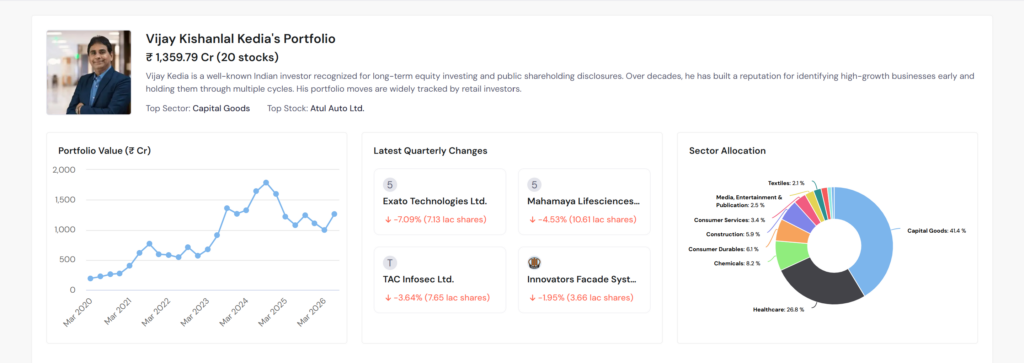
The pattern in his publicly disclosed holdings over the years is consistent with everything his philosophy predicts: small-to-mid cap businesses in sectors with large structural tailwinds, held for years rather than quarters, with minimal churn. Companies like Atul Auto (three-wheeler manufacturer), Vaibhav Global (value-retail jewellery), and others in his portfolio share a common thread, they were not obvious consensus picks at the time of his entry.
His portfolio is not a stock tip list. It is a case study in the application of the SMILE framework in practice, each holding reflects a business with a small market share in a large market, management with demonstrated capability and integrity, and a long growth runway ahead of it at the time of investment.
You can track Vijay Kedia’s latest disclosed portfolio holdings, updated quarterly from official BSE and NSE regulatory filings, on sharpely’s Titan Tracker. The data reflects only publicly disclosed shareholdings above the 1% threshold, updated each quarter as companies file their shareholding patterns.
What to Actually Take Away
Tracking Vijay Kedia’s portfolio holdings is easy. Understanding why he owns what he owns, and what he would say about your own portfolio, requires internalising the philosophy behind it.
The SMILE framework is a business quality filter, not a buy signal. It tells you what kind of businesses to look for. The price you pay and the timing of entry are separate decisions that come after.
Management quality is the primary variable. Financial metrics are outputs of the management’s decisions. Start with the management and work forward — not the other way around.
Market cycles cannot be reliably timed. The response is to own businesses strong enough to survive bear markets and patient enough to compound through bull markets. Exit when the story changes — not when the price falls.
Concentration is not recklessness, it is the logical outcome of genuine conviction. Owning fewer businesses you understand deeply is safer than owning many businesses you understand superficially.
Knowledge, courage, and patience are the actual edge. The first can be developed through research. The second comes from experience. The third requires both, and the discipline to distinguish patience in a good business from stubbornness in a broken one.