

Every investor has a philosophy, even if they have never named it. When you look for cheap stocks, you are applying a value lens. When you chase last quarter’s best performers, you are chasing momentum. When you insist on companies with no debt and consistent profits, you are filtering for quality.
Factor investing takes these intuitions and turns them into something systematic: a data-driven, rules-based approach to stock selection built around characteristics called ‘factors’ that research has shown to be associated with better long-term returns.
This guide explains what factor investing is, where it came from, what the six main factors are, how they have performed in the Indian market specifically, including what has and has not worked since COVID, and how an investor can apply the approach practically.
What Is Factor Investing?
Factor investing is the practice of selecting stocks based on specific, measurable characteristics, called factors, that have been shown through decades of academic research and real market data to explain why some stocks earn higher returns than others over time.
The core idea: stock returns are not random. They are systematically related to certain attributes of the underlying company and its stock. Companies with certain characteristics like cheap valuations, strong profitability, rising price momentum have historically tended to outperform companies without those characteristics, across markets and across time periods.
Factor investing is sometimes called smart beta, systematic investing, or quantitative investing, different names for the same underlying philosophy: let the data, not intuition or market narratives, drive investment decisions.
How It Differs from Traditional Stock Picking
A traditional stock picker reads annual reports, meets management, and builds a conviction-driven view on a specific company. Factor investing does the opposite: it defines a set of rules based on measurable characteristics and applies them consistently across the entire market, without discretion, without narrative, and without the emotional biases that discretionary investors are prone to.
Factor investing’s primary advantage is consistency. A factor-based portfolio does the same thing in every market condition, on every rebalancing date, without being swayed by recent performance or market noise. That consistency is what generates the factor premium (excess returns) over time, and it is also what makes factor investing psychologically difficult, because factors can underperform for extended periods before delivering.
Where Factor Investing Came From
The foundation was laid in 1992 when academics Eugene Fama and Kenneth French published their Three-Factor Model, showing that stock returns could be explained not just by market exposure alone, but by two additional factors: size (smaller companies outperform larger ones over time) and value (cheaper companies outperform expensive ones).
Over subsequent decades, researchers identified additional factors. Mark Carhart added momentum. Novy-Marx introduced profitability. Each new factor had to meet the same standard: persistent across time, pervasive across geographies, and explainable by a logical economic rationale, not merely a data pattern from one lucky period.
Today, factor investing underpins trillions of dollars managed by institutional asset managers globally. What began as academic research is now mainstream, and increasingly accessible to individual investors in India.
The Six Core Factors: What They Are and Why They Work
1. Value
The value factor is based on the observation that stocks trading at low prices relative to their fundamentals. Low P/E, low P/B, low EV/EBITDA have historically delivered higher returns than expensive stocks. The logic: cheap stocks are often cheap because investors are overly pessimistic. When reality turns out less bad than feared, the valuation gap closes, and investors earn the rerating return.
Value investing is not simply buying the cheapest stocks. It requires distinguishing between stocks that are genuinely undervalued versus those cheap because the business is genuinely deteriorating, called value traps. This is why value is most powerful when combined with quality filters.
2. Quality
The quality factor selects stocks based on the financial strength and operational consistency of the underlying business: strong ROE, low debt, consistent profitability, and stable earnings over many years.
High-quality businesses have durable competitive advantages that protect their earnings across economic cycles. They do not blow up during downturns. They compound capital steadily. In the Indian context, quality is particularly powerful as a risk management tool, India’s listed universe contains many businesses with weak governance, high leverage, or highly cyclical earnings. Systematically filtering for quality is a way of avoiding businesses that look attractive in bull markets but destroy capital in corrections.
3. Momentum
The momentum factor is counterintuitive but one of the most robust in academic literature: stocks that have outperformed over the past 6 to 12 months tend to continue outperforming over the next 3 to 6 months, and vice versa. The logic: markets do not immediately price in new information. When a company’s fundamentals improve, it takes months for analyst upgrades and institutional buying to fully reflect that price improvement. Momentum exploits this gradual information diffusion.
Momentum is the most volatile factor, it works strongly in trending markets and suffers sharply during sudden reversals. In India, momentum has been the standout performer since COVID, particularly in mid and small-cap segments where information dissemination is slower and institutional coverage thinner.
4. Growth
The growth factor selects companies delivering above-average revenue and earnings expansion. High-growth companies, those consistently growing sales and profits faster than peers, have historically commanded higher valuations and delivered stronger long-term returns, provided the growth is genuine and durable rather than cyclical or leveraged.
In India, growth is a particularly relevant factor given the economy’s structural expansion. The growth factor, combined with quality filters to ensure durability, has been a consistent return driver in Indian markets. The risk is paying too much for expected growth that does not materialise, which is why growth combined with value discipline produces the best outcomes.
5. Low Volatility
The low volatility factor is academically surprising: stocks with lower price volatility have historically delivered equal or better risk-adjusted returns than high-volatility stocks. The logic: high-volatility stocks attract speculative attention and tend to be overpriced. Low-volatility stocks are stable, less exciting and tend to be systematically underpriced relative to their actual quality.
For Indian retail investors, low volatility is useful as a capital preservation tool in a volatile market. A portfolio of low-volatility stocks tends to fall less steeply during corrections, reducing the behavioural risk of panic-selling at the wrong time.
6. Size
The size factor, the ‘small-cap premium’ observes that smaller companies have historically delivered higher returns than large companies over long time periods. Smaller companies are less followed by analysts and more likely to be mispriced. As information disseminates more widely, valuations tend to rerate.
In India, the size factor has been well-documented. However, it comes with significantly higher volatility and deeper drawdowns during risk-off periods. The size premium requires a long time horizon and the ability to hold through significant short-term underperformance.
The Six Factors at a Glance
| Factor | What It Identifies | Key Metrics | Works Best When |
| Value | Stocks cheap relative to fundamentals | P/E, P/B, EV/EBITDA | Market recovering from pessimism; paired with Quality |
| Quality | Financially strong, consistent businesses | ROE, Debt/Equity, earnings stability | Volatile markets; long holding periods; paired with Momentum in India |
| Momentum | Stocks with recent price outperformance | 6-12 month price return, EPS revision trend | Trending markets; especially mid/small cap in India post-COVID |
| Growth | Companies expanding revenues and earnings fast | Revenue CAGR, EPS growth YoY | Economic expansion; paired with Quality for durability |
| Low Volatility | Stocks with lower price fluctuation | Standard deviation, Beta | Defensive phases; capital preservation priority |
| Size | Smaller companies with higher return potential | Market capitalisation | Long time horizon; ability to tolerate deep drawdowns |
How Factors Have Actually Performed in India, What the Post-COVID Data Shows
Understanding the theory of each factor is one thing. Understanding how they have actually behaved in the Indian market, including recent history, is what turns that theory into useful investing judgment.
Momentum: The Standout Factor Since COVID
Since the COVID low in March 2020, momentum has been the single strongest performing factor in the Indian market. The combination of a sharp recovery rally, a sustained mid- and small-cap bull run, and relatively thin institutional coverage in the sub-₹5,000 crore market cap universe created ideal conditions for momentum to work. Stocks that were already rising continued to rise, and the factor rewarded investors who followed it systematically.
This is consistent with how momentum tends to perform: it is most powerful in trending markets with strong directional price movement, and least reliable when sudden macro shocks force sharp reversals.
Quality: Underperformed in Isolation — But Works as a Complement
Quality, as a standalone factor, has struggled in India since COVID. The post-COVID period has been characterised by a risk-on environment where investors broadly rewarded growth and momentum over balance sheet discipline. Cheap, high-growth, or rapidly-moving stocks often outperformed boring, low-debt, high-ROE businesses that lacked momentum.
This does not mean quality is broken, it means quality should not be used alone in the current Indian market context. The right approach is to pair quality with momentum: screen for high-quality businesses that also show strong recent price momentum. Quality weeds out the operationally weak businesses that momentum would otherwise include; momentum identifies which quality businesses the market is currently recognising and rewarding. Together, they are significantly more powerful than either factor independently.
The QM (Quality + Momentum) combination is specifically designed for this, and as the Indian market has shown, it is more robust than pure quality or pure momentum alone.
The Broader Lesson: Factor Cycles Are Real
No factor works in every market condition. Value underperformed globally for most of 2010–2020. Quality underperformed in India’s post-COVID risk-on environment. Small-cap size premium disappeared during the 2018–2020 mid- and small-cap bear market. Factor premiums are real but cyclical, they accrue over full market cycles of 5–10 years, not over individual quarters or even individual years.
This is the most important practical lesson for Indian investors approaching factor investing: do not abandon a factor after a period of underperformance. The premium exists precisely because most investors find it psychologically difficult to maintain exposure during the downswings. Those who do consistently earn the long-term premium.
Why Multi-Factor Models Outperform Single Factors
Each individual factor has a weakness. Value can stay cheap for years. Momentum reverses sharply in corrections. Quality underperforms in risk-on markets. Small-cap factors suffer in liquidity crises. Low volatility lags in strong bull markets.
This is why the most robust approaches use multiple factors simultaneously, combining Value, Quality, Momentum, and Growth into a single composite score. The factors have low correlation with each other, meaning they do not all underperform at the same time. When momentum is struggling, value may be recovering. The portfolio benefits from whichever factors are in favour while smoothing out the inevitable down-cycles in any single factor.
The academic term is factor diversification, and it is the core principle behind modern quant investing frameworks. A well-constructed multi-factor model does not try to time which factor will work next. It maintains diversified exposure to all of them across a full market cycle.
How sharpely Implements Factor Scores for Indian Stocks
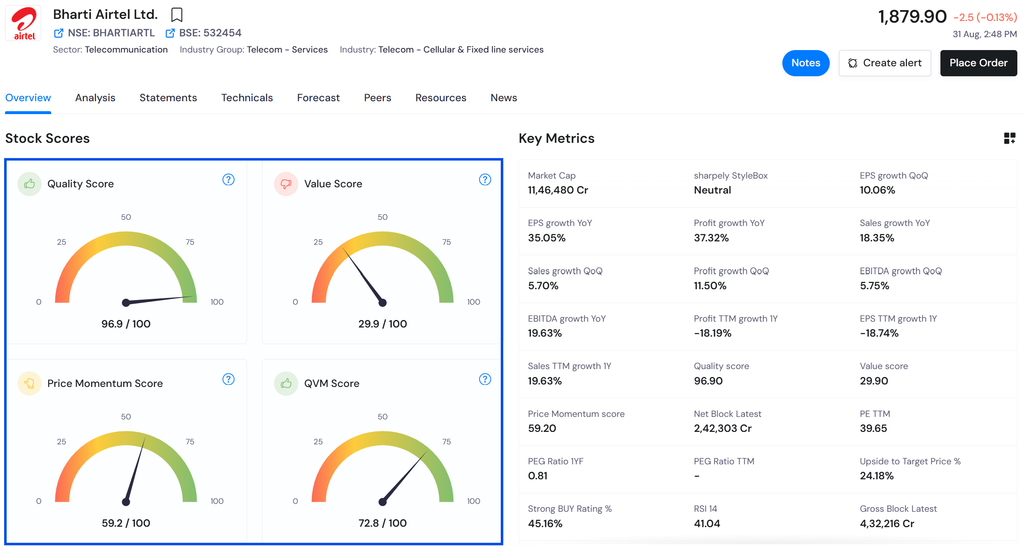
Understanding factors conceptually is useful. Having them pre-calculated, scored, and ready to filter by is what makes them actionable. sharpely computes factor scores for all Indian stocks with a market cap above ₹100 crore, covering the entire investable universe for most retail investors, across single, two-factor, and multi-factor combinations.
Single Factor Scores
sharpely calculates four individual factor scores, each derived from multiple underlying metrics rather than a single data point.
Quality Score: It is inspired by methodology used in the paper (Asness, Frazzini, and Pedersen (2013)).
Accordingly, quality can be broken up into 3 components:
- Safety – Stocks with stable returns and healthy balance sheets.
- Profitability – Stocks with higher efficiency and margins
- Growth – Stocks with growing profitability
Growth Score: Measures the revenue and earnings expansion rate of the business, combining metrics related to topline growth, earnings growth, and the durability and acceleration of that growth over time.
Price Momentum Score: Captures pure price momentum — how strongly a stock has outperformed over recent periods. Derived from price return data across multiple lookback windows.
Price & Earnings Momentum Score: A more comprehensive momentum signal that combines price momentum with earnings estimate revision momentum, capturing both what the market is doing to the price and what analysts are doing to their earnings expectations. This is a more information-rich momentum signal than price alone.
Quality Score — Assesses the financial strength and operational consistency of the business — incorporating return on equity, leverage, earnings stability, cash flow quality, and other balance sheet health metrics.
Value Score — Measures cheapness relative to fundamentals, combining multiple valuation metrics to produce a composite score that is more stable and less subject to single-metric distortion than any individual ratio.
Two-Factor Scores
sharpely also provides pre-computed two-factor combination scores. They are composite scores that blend two factor signals into a single number. These are particularly useful for implementing the factor pairings that work best in practice:
QM Score (Quality + Momentum) — The combination specifically designed for the current Indian market context. Quality filters out operationally weak businesses; momentum identifies which quality businesses the market is currently rewarding. As discussed earlier, this pairing has shown superior results in India’s post-COVID environment compared to either factor used alone.
VM Score (Value + Momentum) — Combines cheap valuation with recent price strength, filtering for stocks that are undervalued but where the market has already begun to recognise and price that value. This helps avoid value traps by requiring a catalyst in the form of price momentum before entry.
QV Score (Quality + Value) — The classic combination of high-quality businesses bought at cheap valuations, the philosophical backbone of long-term value investing. Powerful over full market cycles but can underperform in momentum-driven market environments.
Multi-Factor Scores
For investors who want the broadest factor diversification in a single composite number, sharpely provides two multi-factor scores:
QVM Score (Quality + Value + Momentum) — Combines all three core factors into a single ranking. Stocks that score high on all three simultaneously — financially strong, cheap relative to fundamentals, and showing price momentum — are among the most compelling systematic investment opportunities in any market environment.
QVMG Score (Quality + Value + Momentum + Growth) — The most comprehensive multi-factor score, adding the growth dimension to the QVM combination. Stocks scoring highly across all four factors are genuinely rare, they are high quality, reasonably valued, showing momentum, and growing their business at above-average rates. These tend to be among the strongest compounders in the Indian market over multi-year holding periods.
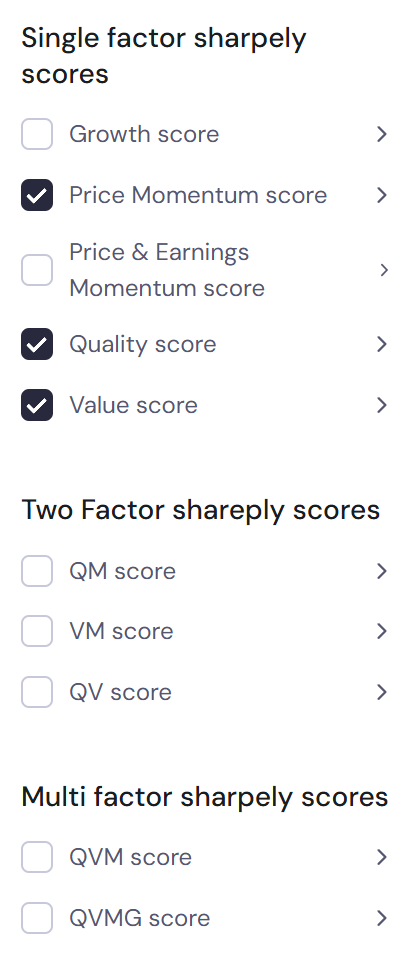
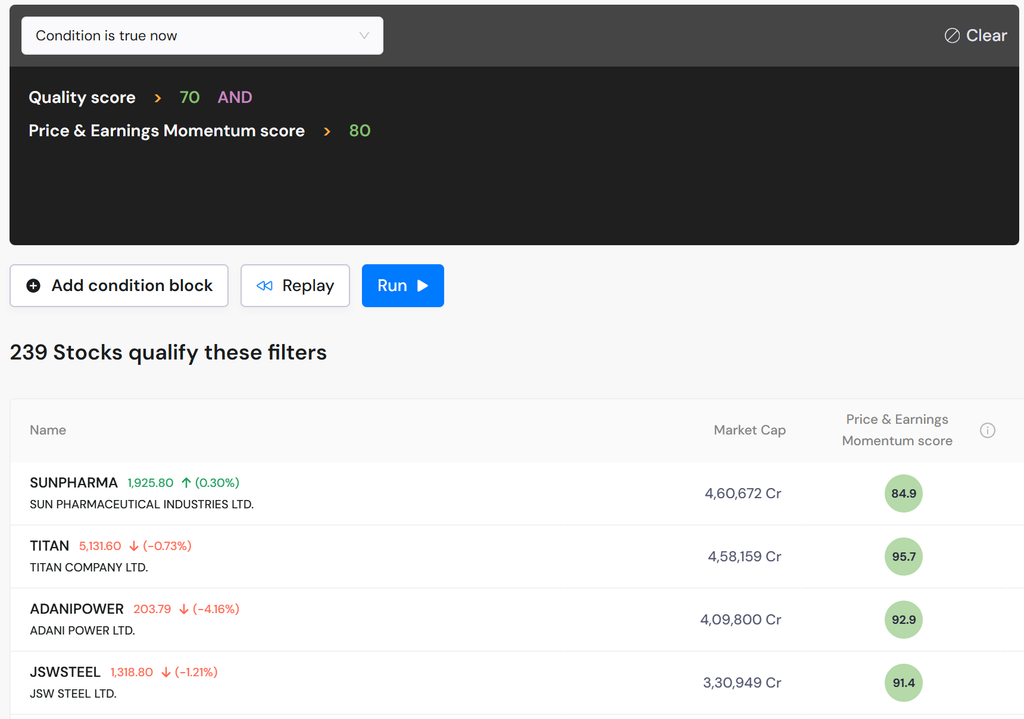
Each of these scores is available for every Indian stock with market cap above ₹100 crore and can be used directly as a screening parameter in sharpely’s Super Screener, making it possible to build a factor-based screen in minutes without needing to construct the underlying metrics from scratch.
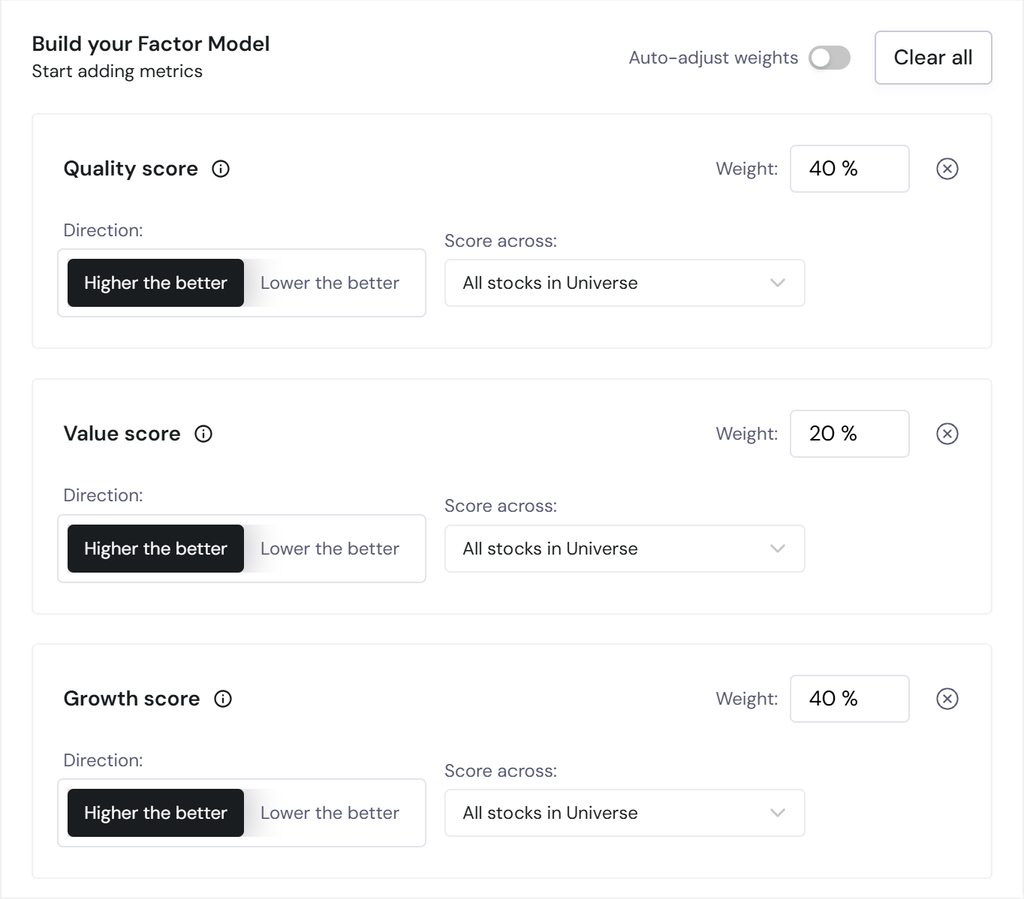
You can also build a fully custom factor model in sharpely’s Factor Model tool, where you define your own weights across factors and backtest the resulting portfolio against historical data.
How to Apply Factor Investing in Practice
Smart Beta ETFs: SEBI-approved smart beta index products in India, including the Nifty Alpha 50, Nifty 200 Quality 30, Nifty 200 Momentum 30, and Nifty 50 Value 20, provide direct exposure to individual factors through low-cost passive funds. These are the simplest entry points for factor-based investing.
Factor Scores in a Screener: Using pre-built factor scores as screening filters, for example, filtering for stocks with a QVMG score above a threshold, lets you quickly build a factor-based watchlist without constructing individual metric conditions. sharpely’s factor scores do this automatically for the full investable Indian universe.
Custom Factor Models: For investors who want to define their own factor weights, how much emphasis to place on momentum versus quality versus growth, sharpely’s Factor Model tool lets you build, customise, and backtest a multi-factor model on Indian stocks, producing a ranked list of stocks by your composite factor score with full historical performance data.
Key Takeaways
Factor investing is systematic, not discretionary. It applies rules consistently across the entire market based on measurable characteristics, removing the emotional biases that affect discretionary stock picking.
Six factors have strong academic and empirical support. Value, Quality, Momentum, Growth, Low Volatility, and Size, each has a logical economic rationale and a documented history of return generation over full market cycles.
In India post-COVID, momentum has been the strongest factor. Quality has underperformed as a standalone but works powerfully when paired with momentum. The QM combination is the most practical pairing for the current Indian market environment.
No single factor works in all conditions, use multiple factors together. Factor diversification, combining Value, Quality, Momentum, and Growth — smooths out the cyclicality of any individual factor and produces more consistent outcomes across market environments.
Factor scores make it actionable. sharpely’s pre-computed factor scores, from single factors (Growth, Quality, Value, Momentum) to two-factor combinations (QM, VM, QV) to multi-factor composites (QVM, QVMG), cover all Indian stocks above ₹100 crore market cap, making systematic factor-based investing accessible without requiring you to build the underlying metrics from scratch.
Patience is the essential ingredient. Factor premiums accrue over full market cycles of 5–10 years, not quarters. Investors who maintain exposure through periods of factor underperformance are the ones who earn the long-run premium.