

Creating an MF or ETF basket
In the last three articles, we focused on one instrument: Stocks. Now let’s shift our focus to instruments that passive investors love: MFs and ETFs.
On sharpely, you can create the mutual fund and ETF baskets rebalance them periodically, and then track their performance. And it is a very straightforward process in a few steps.
The workflow for creating MF and ETF baskets is very similar. So we will take the example of an MF basket and you can create an ETF basket following the exact same steps.
Step 1: Select Instrument
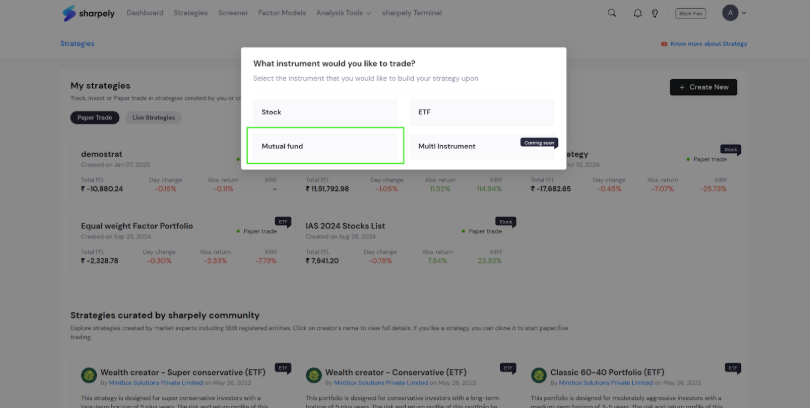
Just like stocks, to create an MF basket, you need to click on Strategies > Create New > Mutual Fund. The image below illustrates the same.
Step 2: Select the funds
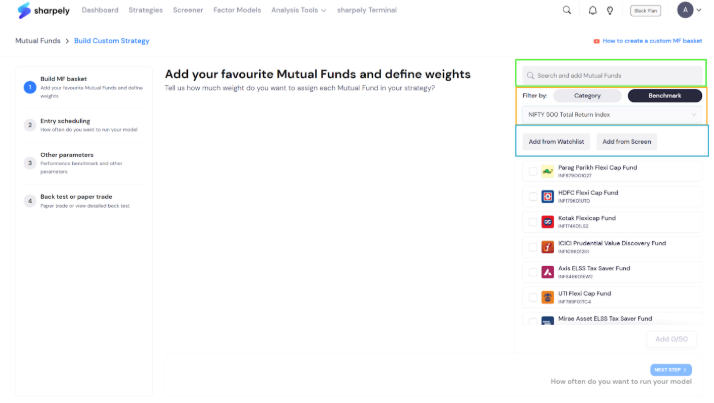
In this step, we will select the mutual funds that we want to add to our basket. Now, there are multiple ways of selecting the funds as shown in the image below.
On top of that, the below images show you the steps involved in the workflow of MF basket creation on the left.
Now let’s look at the different ways to add funds.
The first one is to search for the fund and add it. For that, you have the search bar where you can type the name of the fund and add it by clicking on the checkbox (highlighted in green).
The second way is to filter funds of a specific category or follow a specific benchmark. In the above image, we have filtered MFs following Nifty 500 TRI as their benchmark (highlighted in orange).
And third way is to add funds from your watchlists or screens. You can simply click on the buttons available and add MFs to your basket (as highlighted in blue).
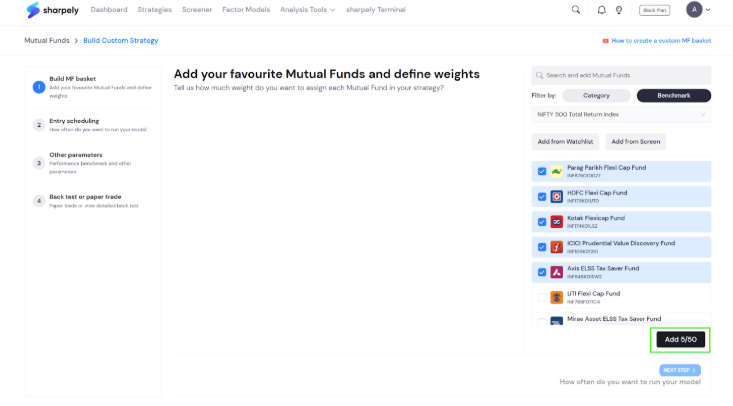
Once you select all the funds click on the add button as highlighted below.
Step 3: Assign the weights
In this step, we will assign the weights to each fund. Here, you have two options as shown in the image below (highlighted in green).
You can assign equal weights (as highlighted in blue) or assign weights manually.
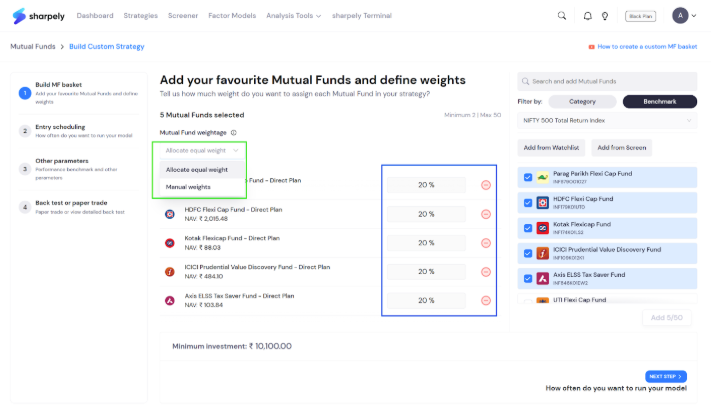
But you have to remember that when you assign the weights manually, the sum of weights should be 100. If the sum will not be 100, you will see a warning message and will not be able to proceed to the next step.
The next step is Entry Scheduling. We have discussed all the remaining steps in detail in an article series on strategy parameters. You can read them here.