
When Numbers Flood In, Knowing What to Look for Is Everything
Every quarter, thousands of Indian companies file their results. Revenues. Profits. Margins. Guidance. The data pours in over a few short weeks, and it can be overwhelming — even for experienced investors.
The real challenge isn’t access to information. It is knowing which numbers actually signal a strong business versus which ones are noise, base effects, or one-off tailwinds.
Most investors end up reacting — reading a headline, checking a stock price, and moving on. What separates systematic investors from reactive ones is a process: a defined set of criteria run against the entire market, surfacing only the companies that genuinely clear the bar.
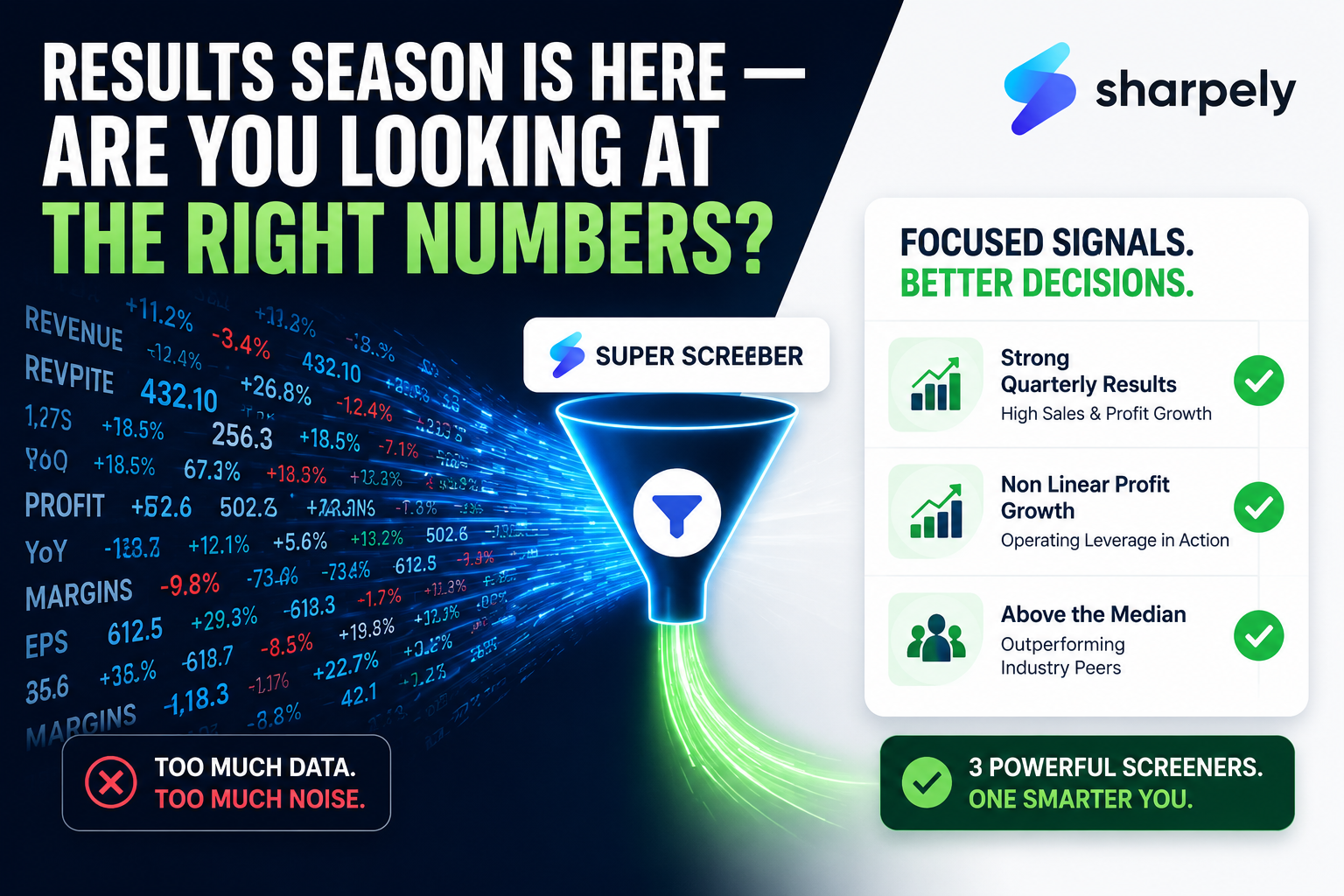
That is exactly what Sharpely’s Super Screener is built for. In this article, we walk through three pre-built screens on Sharpely that are specifically designed to cut through results season noise — each built around a different lens for identifying strong businesses reporting strong numbers.
Why Results Season Demands a Systematic Approach
A single good quarter does not make a business. Companies can post impressive YoY (Year-on-Year) growth simply because the same quarter last year was poor — a phenomenon known as the base effect. Headline profit numbers can jump due to one-time items. Revenue can grow while margins quietly erode.
This is why relying on news headlines during results season is a particularly unreliable strategy. What you need instead are filters — clear, objective conditions that look beyond surface-level numbers and ask: Is this growth real? Is it sustained? Is it better than peers?
A stock screener applies these conditions automatically across the entire listed universe, returning only the companies that meet every criterion simultaneously. No gut feel. No recency bias. Just logic applied consistently.
Sharpely’s Super Screener goes a step further — it allows screens to be filtered by the most recently reported quarterly data, so you are always working with fresh numbers, not stale annual figures.
| 📊 KEY DATA: BSE lists over 5,000 companies. Applying even 5 clear conditions simultaneously can reduce this to a focused, research-ready shortlist in seconds. | Source: BSE India (bseindia.com) |
Screen 1: Strong Quarterly Results
The first screen is the most direct of the three. Its purpose is straightforward: find companies that are growing fast, right now, on both the top line and the bottom line — and continuing to do so sequentially.
It applies a Financial Report Filter set to the most recent quarterly report, which means every condition below is evaluated against the latest filed quarter — not trailing twelve months or annual numbers.
What the Conditions Mean
| Condition | What It Means |
| Market Cap > ₹500 Cr | Filters out very small micro-caps where erratic quarterly swings are common, and liquidity is limited. |
| Sales growth YoY > 20% | Revenue is growing at a meaningful pace compared to the same quarter last year. A 20% bar is high enough to exclude slow growers and base effect beneficiaries. |
| Profit growth YoY > 20% | The bottom line is keeping pace with or ahead of revenue. Ensures topline growth is not getting eaten by rising costs. |
| Sales growth QoQ > 0 | Revenue is higher than the previous quarter — not just compared to a year ago. This filters out seasonal businesses where YoY looks good but momentum has actually slowed. |
| Profit growth QoQ > 0 | Profit is also growing sequentially. Both revenue and profit must be moving in the right direction quarter over quarter. |
| Close > 0.85 × 52-week HIGH | The stock is trading within 15% of its 52-week high. This means the market is already recognising the underlying strength — the stock has not been abandoned despite strong results. |
The QoQ (Quarter-on-Quarter) conditions are what make this screen particularly sharp during results season. Many screens only check YoY growth, which can be misleading when a company had a weak quarter a year ago. By also demanding sequential growth, this screen ensures momentum is current and continuing — not just a recovery from a low base.
Screen 2: Non-Linear Profit Growth with Strong FY Results
This screen is built around one of the most powerful concepts in business analysis: operating leverage. Operating leverage describes what happens when a company’s fixed costs are largely covered — any additional revenue flows disproportionately to the bottom line.
In simple terms: if a company grows its revenue by 15% but its profit grows by 30%, something structurally healthy is happening. Costs are not scaling with revenue. That’s non-linear profit growth — and it is a hallmark of businesses with strong operating models.
This screen also looks at TTM (Trailing Twelve Months) data over both 1-year and 3-year timeframes, which means it is identifying businesses where this pattern is not just a recent blip but a sustained trend.
What the Conditions Mean
| Condition | What It Means |
| Sales TTM growth 1Y > 15% | Revenue has grown over 15% in the past year on a trailing twelve-month basis. The business is not stagnant. |
| Sales TTM CAGR 3Y > 15% | Revenue has compounded at over 15% annually for three years. This rules out one-year spikes — the growth is structural. |
| EPS TTM growth 1Y > 25% | Earnings Per Share has grown more than 25% in the past year — significantly faster than revenue. This is the non-linear part. |
| EPS TTM CAGR 3Y > 25% | EPS has compounded at over 25% annually for three years. Operating leverage is not a recent phenomenon for these companies. |
| PE TTM < 30 | Despite strong earnings growth, the stock is still trading at a Price-to-Earnings ratio below 30 — relatively reasonable for the quality on offer. |
| Market Cap > ₹1000 Cr | Filters for investable, reasonably liquid businesses. Smaller companies are excluded. |
| Close > 0.8 × 52-week HIGH | Stock is within 20% of its 52-week high — the market has not lost confidence in the business. |
The combination of a PE TTM < 30 filter alongside 25%+ EPS CAGR is what makes this screen particularly interesting. You are looking for companies growing earnings rapidly but not yet trading at stretched valuations — a combination that is harder to find than it sounds.
Note that this screen uses FY (Financial Year) results framing — it is best suited for use when annual results have recently been filed, or when you want to identify businesses whose full-year performance confirms what quarterly data has been hinting at.
| 📊 KEY DATA: When EPS CAGR significantly outpaces Sales CAGR over multiple years, it typically signals expanding operating margins — a strong indicator of business quality. | Source: Sharpely Super Screener — Screen conditions |
Screen 3: Above the Median
The first two screens measure a company against absolute thresholds. This third screen asks a different — and arguably more important — question: is this company growing better than its own industry?
A company reporting 15% revenue growth might look impressive in isolation. But if every company in its sector is growing at 25%, that business is actually a laggard. Conversely, a company growing at 10% in a sector where the median growth is 5% is genuinely outperforming its peers.
This screen uses Sharpely’s MEDIAN function, which calculates the median sales and profit growth across all companies in the same industry group. The screen then filters for companies whose own growth exceeds that industry median — on both revenue and profit.
What the Conditions Mean
| Condition | What It Means |
| MEDIAN (Sales growth YoY, by=Industry) > 0 | First checks that the industry itself is growing. There is no point surfacing outperformers in a sector where the whole pie is shrinking. |
| MEDIAN (Profit growth YoY, by=Industry) > 0 | Similarly ensures the industry’s profitability is expanding, not contracting. Filters out cyclically stressed sectors. |
| Sales growth YoY > MEDIAN (Sales growth YoY, by=Industry) | This company’s revenue growth exceeds its industry peers. It is gaining ground, not losing it. |
| Profit growth YoY > MEDIAN (Profit growth YoY, by=Industry) | The company is also more profitable than peers on a growth basis — not just on revenue but where it matters most. |
| Market Cap > ₹1000 Cr | Investability filter — keeps the results within a range of companies accessible to retail investors. |
| Close > 0.85 × 52-week HIGH | Market is pricing in the relative strength — the stock has not been sold off despite strong fundamentals. |
What makes this screen particularly powerful during results season is that it updates dynamically as new quarterly filings come in. As companies report their numbers, the industry medians shift — and the screen recalculates which companies sit above or below. This means it is a genuinely live tool during results season, not a static filter.
The MEDIAN function also makes this screen more robust than one using averages. A single company with extraordinary growth can distort an average, making peers look relatively weaker than they are. The median is resistant to such outliers, giving a cleaner picture of where the middle of the industry actually sits.
| 📊 KEY DATA: Relative outperformance — growing faster than industry peers on both revenue and profit — is one of the strongest indicators of a company gaining competitive market share. | Source: Sharpely Super Screener — Screen conditions |
Key Takeaways
Results season is one of the most data-rich — and most confusing — periods in the investing calendar. The investors who navigate it well are not necessarily the ones consuming the most information. They are the ones with a clear, repeatable process for separating signal from noise.
Each of the three screens discussed here is built around a specific and distinct question:
Strong Quarterly Results — Is this company growing fast right now, on both revenue and profit, with momentum that is continuing quarter over quarter?
Non Linear Profit Growth — Is profit growing faster than revenue over multiple years, suggesting a structurally efficient business with operating leverage?
Above the Median — Is this company genuinely outperforming its industry peers, not just posting decent absolute numbers?
These screens are starting points, not conclusions. A stock passing any of these screens deserves deeper research — into management quality, debt levels, competitive positioning, and valuation. What the screens give you is a focused, logic-filtered shortlist to start that research from.
All three are available on Sharpely’s Super Screener. Head over, run them against the latest quarterly data, and let the numbers do the first round of filtering for you.